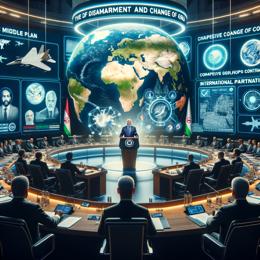
Image created by AI
Europe's Wake-Up Call: The Dire Necessity for Defense Amidst Putin's Threats
The recent Munich Security Conference served as a stark reminder of the escalating threats posed by Vladimir Putin's Russia, and the urgent imperative for European nations to bolster their defense strategies in the face of diminishing certainty over US support. The conference, seething with anxiety and concern over the gravity of Russia's actions and the wavering commitment from the U.S., highlighted that the time for Europe to step up its own defense is now.
The context is alarming: Russia consolidates control over territories in Ukraine, Putin's brazen attitude towards dissent manifests in Navalny's suspicious death, and the looming threat of Russia potentially positioning nuclear armaments in space. These developments demonstrate Russia's clear willingness to disrupt the global order and intimidate its adversaries through asymmetric warfare capabilities.
The contrast with last year's sentiment could not be more pronounced. Where once there was the belief that Russia might suffer a strategic defeat in Ukraine, now that optimism has been replaced with the recognition of a perilous reality, and a recognition that Europe must urgently fortify its own military strength independently of the U.S.
European leaders are acutely aware of their slow response to evolving threats. While plans to reinforce military capacities chug forward, leaders concede that the deployment of these forces is still several years out. Yet, with Russia's aggressive posture, time is a luxury they can no longer afford. European integration must extend beyond economic synergies to include a combined military front that can truly deter Russian aggression.
Indeed, the U.S. reassurance of unchanged leadership and commitment rings hollow without a concrete plan for Ukraine or an elucidated strategy for achieving peace. At the Munich conference, discussions reveal a chilling scenario: in as little as three to five years, Russia might challenge NATO's credibility by attacking a neighboring state, possibly in the Baltics.
While NATO proudly acknowledges that two-thirds of its members have now reached the defense spending target of 2% of GDP, there's a tacit acknowledgment that this figure is woefully outdated. The need to push for higher spending is met with the reality of political obstacles and reluctance for escalation. Even as U.S. support for NATO remains pivotal, Europe acknowledges the need to prepare for a scenario where it might find itself largely on its own.
Europe’s elusive quest for security still grapples with past complacency. Decades of underinvestment in defense have left the continent ill-equipped. Now, Europe must expedite reversing this trend, but there remains a chasm between acknowledgment and action. Deep-set dependence on the U.S., combined with internal political impediments, is slowing Europe’s stride toward a self-reliant and formidable defense stature.
The Munich conference served a sobering reflection for European leaders: emboldening their defensive stance is not optional but an absolute necessity to deter a potential aggressor. Estonia's Prime Minister Kaja Kallas encapsulated this necessity by pointing out that perceived weakness invites aggression. Similarly, Dmytro Kuleba, Ukraine's foreign minister, highlighted the cost of Europe's hesitance – lives that could be tragically lost if Europe cannot promptly fortify its defenses.
The message from Munich is clear: Europe must rapidly recalibrate its defense mechanisms to confront the adversities of an increasingly complex and dangerous geopolitical landscape.
Leave a Comment
Recent News