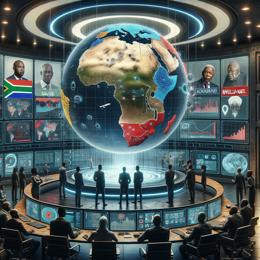
Image created by AI
Nobel Laureate Maria Ressa Challenges the Corruption of Information in the Era of AI Deepfakes
Renowned journalist and 2021 Nobel Peace Prize winner Maria Ressa recently brought to light the insidious spread of misinformation and the threat it poses to democracies worldwide. In a video which depicted her endorsing a cryptocurrency scheme — something she's never done — the specter of deepfake technology's misuse was alarmingly showcased. This fake endorsement is part of a broader issue that is reshaping the very foundations of public discourse and reality.
Speaking in Johannesburg, Ressa reflected on an illustrious, 38-year career in journalism that has been marked by confrontation with powerful adversaries, particularly for her investigative work into the abuses of former Philippines president, Rodrigo Duterte. The dangers she faced then were tangible and direct, unlike the pervasive and abstract challenge misinformation now poses to society.
With social media reaching ubiquity and the advent of AI tools capable of generating fraudulent content at scale, a tumultuous information ecosystem has emerged where falsehoods can be tailored and amplified, creating divergent realities that undermine societal cohesion. This issue is distinctly illustrated by the case of the Philippines, where a sophisticated disinformation campaign rehabilitated the image of the former dictator Ferdinand Marcos, enabling his son's rise to power.
Ressa condemns the role of tech giants, whose content algorithms have become arbiters of what individuals see online. Their reluctance to implement safeguards against fake news has allowed misinformation to proliferate, capitalizing on the viral nature of content imbued with fear, anger, and hate. This negligence has recalibrated the information landscape to favor sensationalist and false narratives over factual reporting.
Highlighting the V-Dem Institute's findings that the majority of the world's population is under authoritarian regimes, Ressa gives credence to the idea that the erosion of the information ecosystem is inextricably linked to the weakening of democratic structures globally. The propagation of lies and the commoditization of misinformation is not only a political concern; it threatens humanity's evolution and moral compass by inundating society with destructive influences.
However, Ressa is channeling her frustrations into actions that foster accountability and integrity within the tech industry and journalism. As a member of the Real Facebook Oversight Board and chair of the World Movement for Democracy's steering committee, she advocates for responsible governance of social media platforms. Moreover, her collaboration with Al Jazeera on a documentary concerning artificial intelligence, as well as Rappler's endeavors in responsible tech use, are testament to her commitment to countering the tide of disinformation with ethical media practices and innovation.
Her visit to South Africa, an engagement for the World Movement for Democracy, underscores the global nature of the struggle for veracity in journalism and the necessity for international collaboration to safeguard democratic values against the onslaught of artificial and malevolent narratives.
Leave a Comment
Recent News