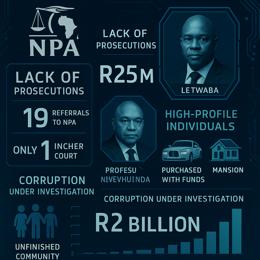
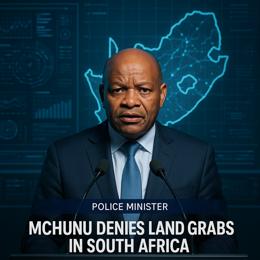
Image created by AI
South Africa at a Political Crossroads: Coalition Conundrums and the Future of Governance
In the tumultuous arena of South African politics, the looming spectre of potential coalitions has stirred a multitude of opinions and fears among the electorate. The Economic Freedom Fighters (EFF), led by the controversial Julius Malema, is at the center of these discussions, prompting some voters to dread the thought of them becoming a part of the next government, or even forming a coalition with the ruling African National Congress (ANC).
Julius Malema, synonymous with a kind of brash populism, has been agitating for the ouster of President Cyril Ramaphosa, advocating for Paul Mashatile to assume leadership. In a hypothetical coalition, Malema positions himself as the deputy president, while Panyaza Lesufi's role in facilitating an ANC-EFF coalition in Johannesburg has been a cause for concern among those who fear what such an arrangement would mean for governance and service delivery.
The Patriotic Alliance (PA), helmed by Gayton McKenzie and Kenny Kunene, both figures with checkered pasts, provides an intriguing subplot to the coalition conversation. Despite a history peppered with anti-ANC and anti-EFF sentiment, the PA currently finds itself sharing local government coalitions where the EFF and ANC have compromised, awarding the PA executive roles without a solid foundation for principled governance.
This arrangement raises critical questions about the long-term implications for South Africa’s political health. McKenzie, once a voice of reason against EFF policies and Malema's political tactics, seems to have softened his stance despite past accusations of Malema being a threat to the nation and a "false prophet." This sudden camaraderie in governance between once-opposed political figures is emblematic of the broader complexities and precarious alliances forming within the landscape of South African local governments.
Yet, critics argue that such partnerships lack substance and vagueness in managing municipal affairs, potentially paving the way for mismanagement and corruption. Moreover, the volatility of these coalitions, particularly the PA's track record of fickle alliances, such as its unreliable stint with the Democratic Alliance (DA), highlights the fragility of South Africa's coalition politics.
The broader political scene sees smaller entities like Rise Mzansi and Mmusi Maimane's new party, Bosa, inadvertently weakening opposition unity by diluting the DA's voter base. Similarly, the elusive Change Starts Now party led by Roger Jardine, despite its initial media buzz, remains an enigmatic force with uncertain political capital.
The ANC's response to its declining dominance has been equally puzzling, exemplified by the decision to send Fear Fokol Mbalula to a conference in Russia composed of countries with questionable records on democracy. At the same time, Naledi Pandor's pursuit of favor in the United States signals a contradictory diplomatic stance. Moreover, President Ramaphosa's strategy of instilling fear among pensioners and grant recipients regarding the continuity of their support should the ANC lose power, echoes manipulative tactics of a bygone era.
South Africa stands at a political crossroads, with the viability of the Multi-Party Charter, an initiative fostering unity among opposition parties, offering a stark contrast to the fragmented political environment plagued by self-serving coalitions. As the ANC verges on losing its majority, the imminent choice for voters is whether to disperse their power among splintering factions or to consolidate it behind a cohesive opposition front — ensuring a robust counterbalance to the potential governance "horror" of an ANC-EFF coalition.
Leave a Comment
Recent News