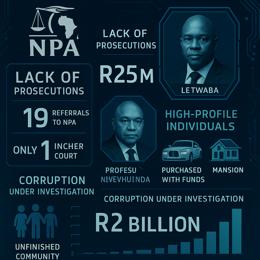
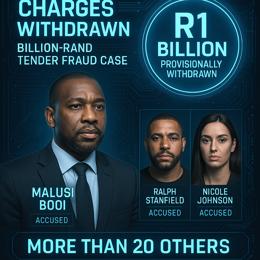
Image created by AI
South Africa’s Constitutional Court Denies Zuma’s Appeal in Private Prosecution Case
In a landmark decision that could resound within the halls of justice throughout South Africa, the Constitutional Court (ConCourt) has struck a decisive blow against former president Jacob Zuma by refusing to hear his application to appeal a ruling related to a private prosecution case. This appeal was against State advocate Billy Downer and another individual, who have been pivotal figures in the corruption allegations against Zuma.
The application in question stems from Zuma's efforts to initiate a private prosecution against Downer and the writer, which the Supreme Court of Appeal (SCA) deemed invalid. The SCA's judgment, characterized by a full bench led by Judge Nathan Ponnan, pointed to the private prosecution as a continued manifestation of what has been termed Zuma's "Stalingrad strategy" - a legal defense tactic involving prolonged and exhaustive legal battles with the intent to delay and obstruct his trial on corruption charges.
The unanimous decision by the ConCourt, significant for its clarity and unanimity, firmly reinforces the SCA's assessments. The apex court maintained that Zuma's case did not fall within its jurisdiction. This rejection is a procedural conclusion, implying that Zuma's legal avenues in contesting this particular matter may have reached an end.
The former president's attempts to challenge his ongoing corruption trial have been numerous and varied, and his Stalingrad strategy has become a point of keen public and legal interest in South Africa. The term draws from the Battle of Stalingrad in World War II, where the Soviet Union's defense strategy involved dragging out conflict to exhaust the Nazis, analogous to Zuma's legal tactics aimed at delaying his trial indefensibly.
The SCA in its ruling expounded that Zuma's actions constitute an abuse of judicial process, defining the private prosecution as a deliberate move not only to evade the trial but also to disqualify Downer, the state prosecutor, from his pivotal role in the impending corruption proceedings.
The impact of the ruling may resonate beyond the immediate sphere of Mr. Zuma's legal battles. It stands as a reinforcement of the judiciary's independence and its intolerance for attempts to misuse the justice system. In directly addressing the abuse of court processes, it also sets a precedent that such maneuvers will not be humored or allowed to derail the administration of justice.
From a political standpoint, this ruling yet again puts a spotlight on the climate of corruption and the legal accountability of high-ranking officials. It reaffirms the judiciary's assertive role in upholding the rule of law amidst political scandal. This decision echoes within a nation all too familiar with tales of graft and postponement in political wrongdoing, offering a potential harbinger of stricter enforcement against such practices.
As the dust settles on this latest legal development, Jacob Zuma and his legal team must revisit their defense strategy in anticipation of the looming corruption trial. With the Constitutional Court having shown its hand, the direction and tenor of Zuma's legal affairs are bound to adjust to this new, more restrictive landscape.
In closing, the ConCourt's decision is seen not only as a setback for the former president's defense but also a victory for the rule of law in South Africa. It signals an optimistic script for the future, where legal tactics aimed at overarching delay may find less and less accommodation within the judiciary.
Leave a Comment
Recent News