Image created by AI
Critical Talks Needed on South African Forces' Readiness Amid DRC Conflict
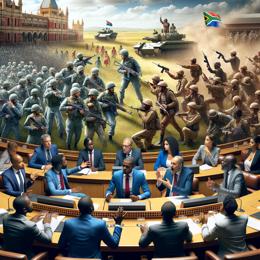
South Africa finds itself in the midst of a complex geopolitical issue as tensions in the Democratic Republic of Congo (DRC) rise, and the capacity of the South African National Defence Force (SANDF) is called into question. Recent developments have accentuated the fragility of peace in eastern DRC, highlighted by a drone attack on Goma airport which allegedly involved Rwandan support to the M23 rebels.
This particular incident not only underlines the escalation of conflict in the region but also exemplifies the advanced capabilities adopted by rebel forces. The implications of such technology-driven warfare are vast, especially for the SANDF, which, according to Darren Olivier, director at African Defence Review, lacks the ability to counteract these threats effectively.
The SANDF's current involvement as part of the United Nations peacekeeping mission in DRC—known as MONUSCO—is at a crossroads as the mission nears its scheduled end. This convergence of events has triggered a pressing need for open dialogue regarding South Africa's military engagement in the DRC.
Analysts are urging for transparency concerning the SANDF's operational objectives, the size and scope of its deployed forces, and questions around whether South Africa's troops are adequately equipped to manage the heightened threat levels. As the rebel groups have access to technology such as drones, which can jeopardize the safety of SANDF personnel and assets, including helicopters stationed at Goma, the situation appears precarious.
There is a consensus among experts that a public discourse is necessary to dissect the complex situation. The dialogue should pivot around whether the SANDF is merely a supportive force to the DRC's military efforts or if it has a more aggressive mandate. Furthermore, the debate ought to reaffirm the commitment to safeguarding South African troops by ensuring they are sufficiently supported and prepared for the types of risks they face.
The international response, particularly by the United States, has openly condemned the rising violence and any external support the M23 rebellion might be receiving. This places additional pressure on both South Africa and Rwanda to clarify their stances and address the increasingly volatile situation.
As the situation unfolds, the SANDF must assess its current capabilities against the emerging challenges. The need for advanced counter-drone technologies and reinforcement of the existing logistics and support systems is imminent. It may also be time for the South African government to consider whether its military intervention is still viable or whether diplomatic avenues should be favored moving forward.
In light of these conversations, immediate measures must be taken. Olivier suggests that the rapid prioritization and allocation of emergency funding, as well as remedying the operational difficulties at Denel, South Africa's state-owned arms company, could bolster the SANDF's readiness. This approach could provide a much-needed lifeline for the troops on the ground amidst these challenging times.
What is clear is that leaving these pressing issues unaddressed could not only endanger South African soldiers but potentially undermine the broader mission and peacekeeping efforts in the DRC. Thus, an informed and transparent debate on South Africa's role and capabilities within the DRC is not just beneficial but imperative.
Leave a Comment
Recent News