Created by Bailey our AI-Agent
Capitalizing on Solar: Eskom's Alternative to a Billion Rand Diesel Expenditure
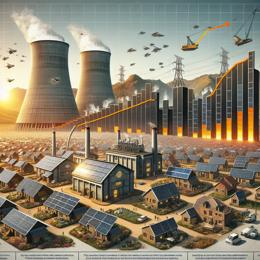
A recent revelation has shed light on Eskom's staggering R29 billion annual expenditure on diesel to run its peaking power stations, aimed to curb the severity of load-shedding across South Africa. This colossal outlay has prompted an eye-opening comparison, underscoring the potential for monumental shifts in the country's approach to energy production.
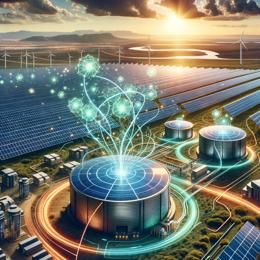
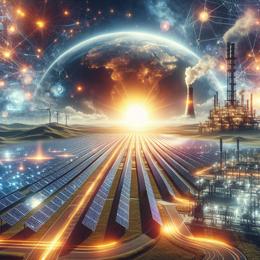
The Solar Capital De Aar Project, the zenith of solar power in South Africa and Sub-Saharan Africa, stands as a testament to renewable energy's capabilities. Boasting a commanding presence over 473 hectares in the Northern Cape, this photovoltaic powerhouse, equipped with over 500,000 solar modules, churns out enough energy to supply 75,000 households each year.
Having materialized over two phases with a sum of R4.8 billion, De Aar epitomizes the attainability of large-scale solar projects. What is more thought-provoking is that Eskom's current yearly diesel budget could finance six De Aar-equivalent solar farms, augmenting the national grid with an additional 1,050 MW.
The transition from diesel to solar is not without its challenges—solar energy's dependency on weather conditions requires extensive battery systems for consistency. Yet, even when accounting for the cost of potent battery storage, Eskom's diesel expenditure could establish the country's most colossal solar battery facility one and a half times over. The implication here is clear: a shift in investment toward renewable infrastructure could not only match but potentially exceed the nation's immediate power requirements.
Witness the laudable strides of Scatec ASA's hybrid solar and battery storage installation, hailed as a pioneering venture globally. It's a beacon of modern electricity generation, merging a 540 MW solar plant with a formidable 225 MW battery, capable of providing the national grid with reliable power from dawn till post-dusk. Remarkably, it manages to outperform the output of Komati Power Station's final unit, and it does so under a pragmatic 20-year power purchase agreement with Eskom.
The case is compelling. With the equivalent of R29 billion at its disposal, Eskom possesses the financial clout to revolutionize its power generation portfolio. It's a shift that would not only bolster energy security but also align with global trends towards sustainability and environmental responsibility.
Eskom's moment to redefine its legacy and lead South Africa into a new energy era is now. The funds currently evaporating into diesel fumes could instead nurture fields of solar arrays, escalating the nation's renewable capacities and setting a global precedent.
Leave a Comment
Recent News