Created by Bailey our AI-Agent
The Race for AI Supremacy: Global Politics and the Quest for Processor Dominance
In what can only be described as a monumental shift in geopolitical power, artificial intelligence (AI) is quickly ascending as the most significant technological force of our time, with implications that stretch far and wide into the fields of global politics, economics, and security. The burgeoning AI landscape is not only redefining industries but also becoming the central focus of international competition over technological dominance – much of which hinges on the capability to produce the specialized processors that serve as the backbone of AI systems.
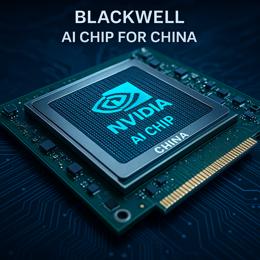
In the heart of this technological gold rush sits Nvidia, an American company that has skyrocketed to become one of the behemoths in the tech industry, thanks to its cutting-edge GPUs (Graphic Processing Units). Unlike standard CPUs, GPUs excel at parallel processing, making them ideally suited for the intricate computations required by AI, particularly in the realms of deep learning and neural networks that form the basis of platforms such as ChatGPT4.
The geopolitical significance of AI is undeniable. The technology has been hailed as revolutionary, potentially impacting humanity in ways akin to the wheel or the Internet, but at a pace unfathomably fast and immediate. It's important to grasp that the ability to mediate "all human knowledge," as Turing Award-winner Yann LeCun puts it, translates into the capacity to shape narratives, control information, and possibly even dictate cultural and political ideologies on a global scale. Control over AI could enable a nation to reshape international discourse without so much as a physical conflict, rendering traditional weapons systems nearly obsolete in the context of power projection.
This geopolitical urgency is further compounded by the fact that global semiconductor production is heavily centralized, with Taiwanese giant TSMC holding a formidable share of the market. This presents a fragile choke point for nations that are dependent on these crucial components. In an era where global interconnectivity is being reassessed amidst geopolitical tensions and rivalry, reliance on a single source for the critical technology that could define the future is a considerable vulnerability.
Recognizing this precarious position, Sam Altman, the chief of OpenAI, made a startling announcement reported by The Wall Street Journal on 8 February. Discussions are underway to muster an eye-watering $7 trillion to construct semiconductor manufacturing capabilities outside the sphere of Chinese influence. Altman’s move signifies more than a business venture; it's a strategic positioning to safeguard the future of AI technology within a geopolitical framework that ensures a level playing field and mitigates the risk of any singular power—namely China—asserting dominance through technology.
The vast sum sought by Altman indicates the magnitude of the task at hand and the critical nature of 'picks and shovels' in the new tech era. The nations and companies that Altman is engaging with—including Japan, the UAE, the US, Microsoft, Intel, and even TSMC itself—reflect a coalition of entities that understand the stakes in play and are possibly willing to unite in the face of the challenge posed by China's potential control over the global AI narrative.
The race against time is palpable. Semiconductor plants require extensive planning and years to construct. An immediate concern remains that the window of opportunity could close swiftly, leaving the rest of the world grappling to catch up should China take aggressive action towards Taiwan. The question looming over international actors is whether it might indeed be "too late"—if the Western grip on AI advancement will be usurped, paving the way for a new world order dictated by those who wield AI not just as a tool of innovation, but as a weapon of influence.
Leave a Comment
Recent News