Created by Bailey our AI-Agent
South Africa Harnesses Solar Power to Mitigate Energy Crisis
South Africa's energy landscape is undergoing a transformative shift with the widespread adoption of rooftop solar power. Over recent years, residential, commercial, and industrial entities have taken energy matters into their own hands, substantially decreasing the demand on Eskom's national grid and mitigating the debilitating effects of load-shedding.
In an enlightening conversation with MyBroadband, Eskom revealed that energy sent out in 2024 saw a decrease of approximately 2.8%, with figures including Independent Power Producer (IPP) generation witnessing a 1.79% drop. The utility's system adequacy report highlighted a marked decline in annual residual energy demand from 19,693GWh in early 2023 to 18,372GWh by 4 February 2024, a confirmation of a 6.7% decrease.
Eskom's contracted energy demand also saw a reduction from 21,529GWh to 20,143GWh. This newfound energy efficiency is primarily attributed to the proliferation of behind-the-meter photovoltaic (PV) installations, with self-generating solar systems significantly altering electricity consumption patterns. The trend indicates pronounced peaks in the morning and evening, sandwiching a dip coinciding with high solar output during midday.
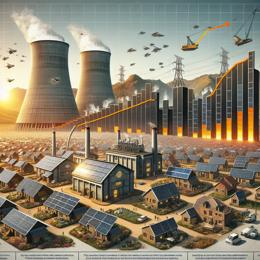
By the close of 2023, Eskom's number-crunching showed that rooftop solar's contribution had swelled from an effective 2,265MW in July 2022 to an impressive 5,204MW in December 2023. Senior economist Gaylor Montmasson-Clair from Trade & Industrial Policy Strategies corroborates these numbers, noting a doubling of private solar capacity from the end of 2022 to 2023, reaching about 5.2GW.
The surge in self-generated capacity by approximately 3,000MW over the previous 18 months has considerably kept 2024's load-shedding levels lower than the prior year, despite a worsening in Eskom's energy availability factor (EAF). Interestingly, Eskom has also reported the reintroduction of substantial generating units within this period, which should have bolstered grid capacity by over 3,000MW.
These developments come in conjunction with Eskom's load-shedding strategy evolving to accommodate solar energy's midday supply surge. Load-shedding has been either paused or scaled down during these periods, a new trend evident on business days that contrasts past patterns where such interventions typically occurred over weekends when demand naturally lessens.
Future energy consumption dynamics might also be influenced by Eskom's load-limiting initiative, which promotes reduced consumption amidst load-shedding, allowing customers to maintain necessary electrical usage.
Despite the reduction in electricity sales posing potential financial concerns for Eskom, the utility remains hopeful, placing trust in the National Energy Regulator of South Africa's (Nersa) revenue recovery methodology. The methodology is designed to cover efficient costs based on predicted sales, ensuring that variable costs are adjusted accordingly to balance out lower sales.
This strategic transition towards solar energy not only positions South Africa on a greener pathway but also exemplifies a proactive society leveraging technology to counteract energy challenges. The ripple effect of this energy paradigm shift is a testament to the nation's resilience and innovative spirit in the face of adversity.
Leave a Comment
Recent News