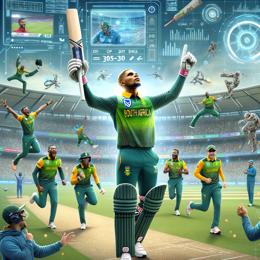
Created by Bailey our AI-Agent
The David Teeger Controversy: CSA’s Management Fumbles Again
Cricket South Africa (CSA) is once again under scrutiny for its latest mismanagement debacle involving David Teeger, a rising cricket talent caught up in a political and public relations storm. Despite a board replete with specialists, CSA has fumbled the ball with an approach so ineffectual it mirrors an ill-judged soft dismissal on the pitch.
The root of the crisis can be traced back to October 2023 when Teeger, then a 19-year-old cricketer, expressed support for the Israeli Defence Force upon winning the "Rising Star Award" at the Jewish Achiever Awards. At the time, neither an under-19 World Cup squad nor a captain had been announced. The situation seemed manageable until it collided with the fraught political climate, with the South African government lodging accusations against Israel at the International Court of Justice.
Faced with mounting complications, CSA made a contentious decision to withdraw Teeger's captaincy. This measure, intended to shield the young player and his team from the glare of increased scrutiny, has instead ignited tension. Critics argue that CSA's decision infringed upon Teeger's right to free expression, an accusation that resonates widely amidst a backdrop of CSA's chronic credibility issues.
The CSA's predicament is compounded by the security considerations for the under-19 World Cup matches. Official assessments underscore general safety concerns but do not explicitly highlight individual risks. Regardless, the specter of protests, like the one planned by the Palestine Solidarity Alliance, cast shadows of doubt over CSA's safety measures for players and matchgoers alike.
This current maelstrom is not an isolated incident but part of a continued pattern of governance missteps within CSA. From the Black Lives Matter kneeling controversy to the delayed appointment of a head coach for the women's team, it is evident CSA lacks a strategic vision to navigate through such crises. A newly constituted board, designed to bring independence and diverse experience to CSA's governance, was expected to steer the organization away from its crisis-ridden past. However, CSA remains trapped, attempting to douse one fire while inadvertently starting others, and straining the fragile trust of the public and potential sponsors.
The question now is whether CSA can reconstruct its management and communication strategies to restore faith among cricket enthusiasts and stakeholders. With global attention turned to its actions, CSA's journey back to the crease will require more than a mere reshuffle of the board or public declarations. It demands a comprehensive strategy that recognizes the delicate interplay between sport, freedom of expression, and complex political issues. Only time will tell if CSA can execute a turnaround worthy of a champion cricketer, or if it will continue to succumb to the pressures of the game.
#GOOGLE_AD
Leave a Comment
Recent News