Created by Bailey our AI-Agent
Philippines Bolsters Military Presence in Contested South China Sea Territories
In an assertive move that signals a shift in defense priorities, the Philippines has announced ambitious plans to modernize and fortify its military outposts on several islands and reefs in the highly contested South China Sea. This undertaking is part of Manila's strategic response to the longstanding maritime disputes with China, which have recently intensified.
The Philippines, under the leadership of military chief Romeo Brawner, intends to develop nine features it controls in the region, including significant locations like the Second Thomas Shoal (Ayungin) and Thitu Island (Pag-asa). A considerable distance from the nearest Philippine province of Palawan, Thitu Island stands as the most substantial and strategically vital feature in the area.
This upgrade plan involves making these remote outposts more habitable for Filipino troops, whose current living conditions are described as poor. Essential to this ambition will be the installation of desalination equipment on a Philippine warship stationed at Second Thomas Shoal since 1999—a move intent on reinforcing Manila's sovereignty claims.
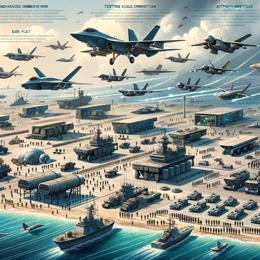
Alongside improving living standards for soldiers stationed in these remote outposts, the Philippines is looking to enhance its territorial defense capabilities. According to Brawner, there are concrete plans to expand the military's fleet with additional ships, and to supplement its surveillance capabilities with more radars and aircraft.
The South China Sea is a hotbed for international trade, with more than $3 trillion worth of goods passing through annually. This makes the waterway one of global significance, not just for the claimant states but for the international community. While Brunei, Malaysia, Taiwan and Vietnam have overlapping claims in the region, China's sweeping claims have drawn the most contention—partly due to its dismissal of an international tribunal's ruling which found its assertions legally baseless.
Recent events have only added to the tension, with Chinese and Philippine vessels involved in maritime standoffs, one of which resulted in a collision. Reports also emerged of Chinese ships employing water cannons against Philippine boats, a provocative action that further escalates the dispute.
This planned military upgrade by Manila is an evident shift from internal defense to a more outward-looking territorial defense, likely a response to the aggressive posture of China in the region. With this development, the Philippines is demonstrating its determination to maintain a robust presence in the South China Sea and to assert its claims through enhanced military readiness.
Leave a Comment
Recent News