Content created by AI
Volcanic Eruption Near Iceland's Popular Tourist Destinations Raises Alarm
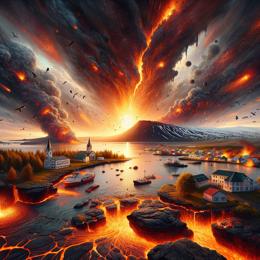
Iceland's southwest finds itself in the throes of nature's fury, as a volcanic eruption commenced near Grindavik, a fishing town recently evacuated due to increasing seismic disturbances. This town, of roughly 3,700 inhabitants, now stands empty as the earth splits open in a display of molten power just 40 kilometers from the island's capital.
The eruption, which began at night, was confirmed by the Met Office at 10:17 p.m. local time. A Coast Guard helicopter was promptly dispatched to assess the scale and location of the event. As lava fountains rocket over 100 meters into the sky and lava flows from a 2-3 kilometer fissure, the surrounding area, rich in geothermal activity, braces for the short and long-term consequences.
Despite the eruption's intensity, operations at Keflavik International Airport continue uninterrupted, avoiding the chaos that dominated the airspace during the notorious 2010 Eyjafjallajokull eruption. Professor Thor Thordarson of the University of Iceland provided reassurance on the current eruption's limited impact on air traffic but warned of significant threats to local infrastructures such as Grindavik town, the Blue Lagoon geothermal spa, and the Svartsengi power plant, which stands crucial in supplying heat to nearby residents.
This eruption is not the peninsula’s first in recent times; following nearly eight decades of dormancy, the ground split in 2020, 2021, August 2022, and now again, turning what was once a geological oddity into a pattern of resurgent activity. Unlike the ash-producing Eyjafjallajokull, this eruption emits effusive lava, with its proximity to the sea holding the potential for explosive outcomes, especially if the fissures extend into maritime domains.
Icelandic authorities, well-versed in volcanic events, continue to monitor the situation through seismic data and aerial reconnaissance, assured by the less severe repercussions of effusive eruptions compared to their ash-producing counterparts. Yet, the memory of the 1973 Westman Islands event, where lava entombed parts of an inhabited area, lingers as a somber reminder of the latent peril.
The economic and ecological risks are evident. The Blue Lagoon, an iconic destination for travelers worldwide, along with the Svartsengi plant, pivotal for geothermal ventures, could face dire long-term issues if the lava encroaches on these zones. For Grindavik, dependent on both its marine and geothermal resources, the eruption poses an existential threat, potentially generating environmental and economic upheavals.
Residents of the Reykjanes Peninsula, while familiar with the land's fiery breath, have not faced an eruption threatening their homes to this extent since the 1970s. As officials and specialists keep vigilant, the people of Iceland, living on a land both beautiful and volatile, hold their breath, hoping the earth's restlessness subsides and spares the heart of their livelihoods.