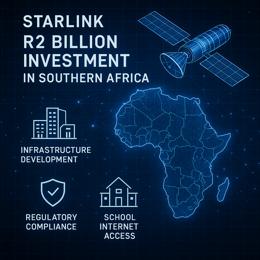
Content created by AI
The Battle for the Stars: Starlink's Legal Tangle in South Africa and the Threat to Local Telcos
In an unfolding narrative that reads like David vs. Goliath, South Africa finds itself in the crosshairs of a technological revolution that could rearrange the country's telecommunications landscape. SpaceX's Starlink, the brainchild of billionaire Elon Musk, is firmly at the center of this potential upheaval. With its innovative low-earth orbit (LEO) satellites promising to deliver high-speed internet across the globe, traditional mobile operators like Vodacom and MTN are bracing for impact.
Dominic Cull, a veteran telecommunications industry regulatory expert, has drawn attention to the legal tussles currently obscuring Starlink's prospects in South Africa. The Independent Communications Authority of South Africa (Icasa) tagged Starlink's local operations as illegal, pointing to the lack of necessary licenses – a situation that has sparked a prolonged and complicated back-and-forth, leaving companies and consumers in limbo.
The admission ticket to South Africa's telecommunications show is not cheap. Licenses for Individual Electronic Communications Service (I-ECS) and Individual Electronic Network Service (I-ECNS) run into millions of rand – barriers not easily surmounted by newcomers and a thorn in the side for competition and transformation in the industry. Cull's commentary clearly outlines the intricacies of South Africa’s regulatory environment that, while safeguarding the interests of historically disadvantaged groups (HDGs), also imposes tough equity ownership stipulations.
This stringent regulatory framework has been no walk in the park for Starlink, which has not only been grappling with hefty license fees but also facing a gauntlet of equity ownership requirements. Initial enthusiasm for a launch in 2022 has dwindled, with the latest updates from the Starlink camp suggesting an indefinite delay in their South African venture, highlighting broader regulatory uncertainties that repellently linger.
Meanwhile, local heavyweights are not sitting back as spectators. Vodacom's alliance with Amazon’s Project Kuiper and its foray into handset-to-satellite communications signify a strategic pivot to preemptively stave off emerging competitors. Even MTN, more reticent in its public stance, appears to be cautiously positioning itself by exploring similar satellite technologies.
What makes this scenario particularly intriguing is the potential market disruption LEO satellite networks can cause to South Africa's established telecommunications hierarchy. Starlink's business model, characterized by a direct-to-consumer approach, might reroute revenues, traditionally pocketed by local providers, into international coffers. Cull raises a salient point about the economic implications for South Africa, where local supply chain disruption by foreign entities is far from a welcome prospect.
Despite attempts by Ispa to engage with Starlink in the hopes of forging beneficial reseller agreements for local internet service providers, the communications from the SpaceX-side remain eerily silent, mirroring the unresponsiveness that South African media has contended with.
As the telecommunications drama unfolds against the backdrop of red tape and regulatory rigor, the nascent LEO satellite sector looms ominously over the established telco giants. The formidable technological prowess of Starlink, paired with a precarious legal pathway, poses a narrative rich with complexity and consequence for South Africa’s digital future.
Leave a Comment
Recent News