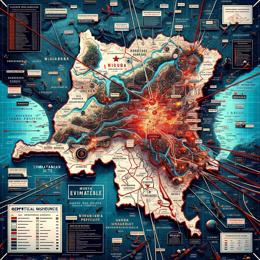
Image created by AI
Deadlock Shifting War Momentum in Favour of Russia, Zelensky Rallies Defence Amid Dire US Intelligence Warnings
In a complicated twist of events, Ukrainian President Volodymyr Zelensky has expressed a bold confidence in his military's ability to stabilize the front against Russian forces, even as US intelligence agencies warn of a shift in momentum that could favour Moscow. In recent reports, the deadlock appears to be giving strategic advantages to Russia, which has made consistent battlefield gains since late 2023, exacerbated by the ambiguity surrounding the continuation of Western military support.
Zelensky, during his interview with BFM TV, showcased a positive front, highlighting the halting of the Russian advance and improvement in the front-line situation compared to the past three months. His assurance is however marred with a sense of urgency for increased military aid from the West, hinting at the vulnerability of Ukraine's position without it.
The assurances from President Zelensky come at a time when the US-based Institute for the Study of War reported Russian advancements near Bakhmut and Avdiivka in Ukraine’s east. These developments have prompted US intelligence agencies to alert senators on the evolving dynamic in Ukraine, with the deadlock increasingly working in Russia's favour.
Under the backdrop of this tug-of-war, Ukraine is fast-tracking the construction of 2,000km of defensive fortifications, as acknowledged by Zelensky on Telegram, following a report from Prime Minister Denys Shmyhal. Despite the concerted efforts to build these defences, Ukraine is grappling with a dearth of ammunition and a delay in a sizeable $61-billion aid package from the US.
CIA Director William Burns asserted in a Senate testimony that Ukraine's bottleneck is not the lack of courage but ammunition, and time for aid is running out. His comments come with a stark warning that Ukraine could stand to lose significant ground in 2024 without further assistance.
Amidst these military considerations, Zelensky also decisively downplayed the possibility of French military deployment on Ukrainian soil, stating such an act would only occur if Russia invaded a NATO member, triggering an alliance-wide response.
This contradiction between the Ukrainian leader's assertive discourse and intelligence reports extends to the economic side of the war, where Russia is contemplating substantial tax increases to bolster its wartime budget. Among the propositions are tax hikes on personal incomes and corporate profits, aimed at generating significant revenue to counteract the financial burdens of the ongoing conflict.
Furthermore, Russia is pursuing financial tactics to mitigate the sanctions' impact, appointing a broker to assist with asset exchanges between Russian and foreign investors affected by international sanctions.
In summary, while President Zelensky radiates optimism and determination, the stark assessments from US intelligence agencies present a grim picture of what could lie ahead without augmented support from the West. The amalgamation of fortified defences, potential tax hikes, and strategic asset management reveals the enduring and adaptable nature of the conflict in Ukraine.
Leave a Comment
Recent News