Image created by AI
South Africa's Pursuit of Sustainability and a Greener Economy Amidst Climate Challenges
As South Africa commemorates three decades of democracy, a critical eye turns toward its ongoing journey of cultivating a just, equitable society—a journey intertwined with the principles of sustainability. The nation's pathway unites various sectors and delineates that decisions made in one realm inevitably affect all others. Today, the spotlight falls on the environment, economic progress, and the pursuit of social justice, fused under a strategy known as the Just Transition.
A recent State of the Nation Address (SONA) by President Cyril Ramaphosa was notable for accentuating governmental triumphs rather than the stark realities faced by many South Africans. Nevertheless, the address did not entirely overlook aspects pivotal to socio-economic and environmental sustainability, elaborating on a few key areas.
One such area is infrastructure, which remains a decisive element for economic stimulation and enhancing people's lives—especially in underprivileged regions. Investments in infrastructure mirror the country’s Sustainable Development Goals (SDGs) commitment and present a chance to promote greener solutions. Improvements to transport, water supply, and energy systems are not only necessary for basic services but are also precursors to economic and social integration.
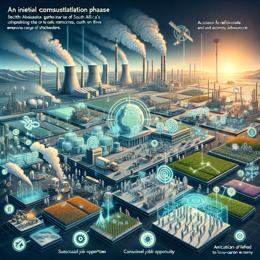
SONA also underscored South Africa’s transition to renewable energy. Shifting focus to the Boegoebaai green hydrogen project and the impetus on developing electric vehicle (EV) infrastructure demonstrates the nation's resolve to curtail carbon emissions. This shift promises improved public health through better air quality and positions historically coal-dependent areas like Mpumalanga for an economic renaissance powered by renewable energies.
Moreover, the session highlighted international collaboration, particularly with Botswana and the Democratic Republic of the Congo (DRC). The DRC's mineral wealth is essential for renewable energy technology production, which, if harnessed sustainably, could augment South Africa’s green aspirations. Collaborating with Botswana on the automotive value chain potentially leads to novel green technology and job prospects.
Climate change mitigation was addressed as an area requiring urgent attention, citing severe droughts, floods, and wildfires that have afflicted the country. Here, a parallel was drawn between the proposed Climate Change Bill and a new Climate Fund likened to the pandemic-era Solidarity Fund. Contributions from diverse sectors would fuel this fund, tasked with combating climate impacts through tangible initiatives. However, the administration and effectiveness of such a fund remain subjects for future discourse and action.
The Climate Change Bill of 2022 embodies a legislative response to these environmental challenges, intending to drive a low-carbon, climate-resilient transition. Inherent in this bill and subsequent policies is the need for robust financial backing to implement climate-related legislation effectively. This necessitates stringent governance and accountability mechanisms to ensure that financial resources are well-allocated and objectives are met transparently.
Realizing these ambitious goals involves a comprehensive approach, engaging stakeholders across government and industry in a concerted effort. The Bill seeks to create harmony among various policies, avoiding redundancy and conflicting interests while maximizing synergistic opportunities.
As we stand on the brink of manifesting this vision, the capacity to fuel and actualize these plans elicits anticipation. South Africa has laid down a pathway suggestive of a verdant and sustainable future. The enthusiasm spurned by SONA's deliberative content must now transition into a spirited and actionable plan, embodying the resilience and foresight reflective of South Africa's pursuit of a greener tomorrow.
Leave a Comment
Recent News