Image created by AI
South Africa's Nuclear Ambitions: Mantashe Urges For Domestic Uranium Utilization
In a decisive push toward energy sovereignty and diversification, South Africa's Minister of Mineral Resources and Energy, Gwede Mantashe, has publicly urged the United States to respect his country's pursuit of nuclear energy development. This demand aligns with South Africa's ongoing strategy to deepen its energy sources and reduce reliance on imports.
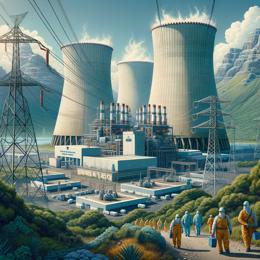
The call was made at the recent Africa Energy Indaba, where Mantashe highlighted the strategic value in turning South Africa's ample uranium reserves into nuclear fuel. Currently, the country relies on imported nuclear fuel components from both the US and France for its Koeberg power station, the continent's lone nuclear facility, which accounts for a sizable 5% of national electricity production.
Under existing international protocols, agreements such as the one in Section 123 of the US Atomic Energy Act of 1954 have placed strict safeguards on nuclear materials, aimed primarily at thwarting the development of nuclear weapons. South Africa is presently engaged in discussions with the US regarding the renewal of Koeberg's operational license and the plant's expansion, affirming its commitment to nuclear energy's peaceful pursuits.
The Energy Minister's stance resonates with South Africa's prior efforts to expand its nuclear capacity — a contentious plan that had previously seen setbacks under Jacob Zuma's presidency when bids to procure substantial nuclear energy through the Russian state-owned Rosatom were legally challenged and subsequently halted.
Organizations such as Earthlife Africa and the Southern African Faith Communities’ Environmental Institute played instrumental roles in this interruption, reflecting vigilant societal oversight within South Africa's pursuit of nuclear investments.
Addressing past controversies, Mantashe assured that the nation's renewed interest in nuclear energy would be cautiously approached, emphasizing affordability and economic prudence. Echoing the EU's encouraging taxonomy for green investments, which has lately endorsed nuclear and gas energy, Mantashe is steering South Africa towards a larger goal of 2,500 additional megawatts of nuclear generation capacity that will complement Koeberg.
Electricity Minister Kgosientsho Ramokgopa had previously revealed strategies to achieve this goal within a 10 to 12-year timespan, as outlined in South Africa's Integrated Resource Plan of 2019. This forward-looking approach is considered vital in remedying the existing deficit in electricity generation that has plagued the region.
In contrast, energy expert Mark Borchers, along with other skeptics, challenges proponents to present more compelling justifications for nuclear energy investment, taking into account the long gestation periods and high expense often associated with nuclear developments.
This week's Energy Indaba participants, comprising stakeholders from various sectors, have advocated for nuclear and gas as pivotal to resolving South Africa's energy conundrum. They argue that, relative to renewables, these options are more reliable, offering continuous baseload power supply at competitive costs.
Titus Mathe, head of the South African National Energy Development Institute, and Mzi Tyhokolo, CEO of Spring Lights Gas, emphasized the critical role of a dependable energy supply in combating poverty. They envisage a future where nuclear and gas not only drive energy reliability but also spur job creation.
The South African government's position appears to challenge prevailing energy paradigms, situating nuclear and gas in direct competition with renewable solutions to tackle present and future power crises.
Leave a Comment
Recent News