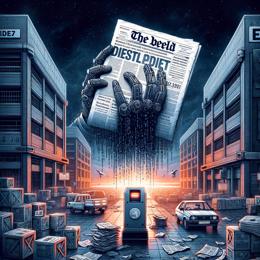
Image created by AI
The Tug-of-War: Media Industry Challenges in the Digital Era and the Commission's Inquiry
This week marks the commencement of a crucial inquiry by the Competition Commission into the operation of digital platforms in the distribution of news content. At the center of this investigation is a profound question that pertains not only to the future of a free press but also to the integrity of the marketplace of ideas: Are certain behaviors of dominant players like Google and Facebook thwarting competition?
The Media and Digital Platforms Market Inquiry dives deep into two pivotal concerns - the 'search issue' and 'programmatic advertising'. With a rapidly evolving media landscape where once-revered pillars of journalism face an existential crisis, these are not mere theoretical debates but matters that could reshape the flow of information in society.
For decades, traditional news organizations have been bastions of information, serving crucial roles in democracy. However, the landscape has dramatically changed. A stark example is The Star newspaper, whose plummeting circulation from 230,000 to about 8,000 exemplifies a broader global trend of declining journalistic enterprises and shrinking newsrooms.
The query is whether the digital giants are playing a fair game. With a business model that leverages content produced by others at minimal cost, platforms like Google benefit from the traffic generated through news searches without a proportionate investment in the creation of the content itself. Simultaneously, these platforms profit exponentially from the commoditization of user attention through sophisticated programmatic advertising systems.
The giants of Silicon Valley argue that they have simply created superior systems for distribution and advertising in the digital world - platforms that have revolutionized access to information and products. However, this argument is increasingly scrutinized for its implications on diversity of news and the financial viability of news production.
To delve into the specifics, Google, for instance, is more than a mere search conduit. It controls multiple arms of the online advertising ecosystem, acting not just as a channel, but a full-spectrum broker that offers demographic-specific advertising options. The efficiency and targeting these platforms afford advertisers sharpen a double-edged sword: while they might deliver unrivaled reach and results, they simultaneously siphon away the lifeblood of revenue that once sustained traditional media.
This overwhelming advantage in aggregation and distribution poses an existential risk to legacy media and up-and-coming independent publishers alike. While theoretically open to competition, in practice the scale and pervasive reach of these digital behemoths make alternative systems almost residual.
The inquiry must grapple with the reality that while fines may penalize such dominance, they are not a panacea. The damage to the media industry is not retroactively repairable with penalties. The commission's task is nuanced and complex; it must discern if the market dominance observed is indeed destructive, while fostering an environment that allows the media to adapt and thrive in the digital age.
This inquiry is not just an academic exercise. Its outcomes could determine the viability of the media industry and the quality of information available to the public – ensuring the richness of the marketplace of ideas doesn't wane in the digital age, and that the very essence of democratic discourse isn't commoditized to the point of irrelevance.
Leave a Comment
Recent News