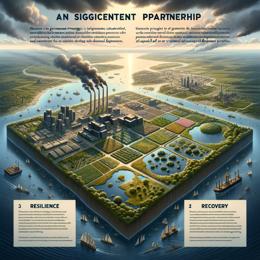
Image created by AI
The Heavy Toll of Living Amidst Vaal Triangle's Toxic Air
The Vaal Triangle, a mere 30 miles away from the bustling city of Johannesburg, presents a grim tableau of the cost of industrial progress on human health. With a population of 1.7 million people living under a persistent cloud of noxious smog, it stands as a monument to the world's most acute pollution crisis. The region's steel mills and coal-fired power plants are the linchpins of local economies, yet they exact a heavy price in the form of air contaminants that compromise the well-being of the community.
Vanderbijlpark's massive steel mill, accompanied by the Lethabo coal power plant and a petrochemical plant in Sasolburg, the epicenter of the region's industrial prowess, contribute significantly to a level of toxic emissions unmatched globally. Despite the area's employment opportunities, the resultant pollution has linked these industries to hundreds of premature deaths and a spectrum of respiratory ailments among the local populace.
Historically, Vereeniging's roots delve deep into the economic surge South Africa experienced following its first coal discovery. However, the prosperity once symbolized by the now-museum piece last lump of coal contrasts with its present-day reality of ominous pollution levels. Vereeniging consistently tops charts for PM2.5 emissions, which include deadly particulates capable of inducing cancers and heart diseases.
The South African government's recognition of the severity came as early as the mid-2000s, with the designation of the Vaal Triangle as a priority area for air quality improvement. However, industrial resistance, legal exemptions, and a failing municipal waste system have impeded progress. The air that residents breathe remains laden with pollutants, a consequence of the area's reliance on high-emission coal and lack of stringent regulatory enforcement.
The impending 2025 environmental regulations signal a stand-off between health imperatives and economic survival. Legal challenges and international pressure underscore a looming necessity for change. Yet, local reality paints a bleaker picture, as waste goes uncollected, contributing further to particulate emissions, and companies struggle to balance compliance against financial constraints.
Ironically, in a cruel twist of fate, residents who suffer from the ill effects of pollution, like Portia Mofokeng and Kido Mafisi from the impoverished townships near the industrial plants, see these emissions-churning facilities as their only employment lifeline. The dilemma between health and livelihood encapsulates the core challenge that the Vaal Triangle faces as it confronts its toxic legacy while trying to navigate a path toward sustainability.
Efforts by companies such as ArcelorMittal, Sasol, and Eskom—to cut emissions and establish offsets—are incremental steps towards reconciling industry with environmental stewardship. The push for greener alternatives, such as Sasol's pilot green hydrogen facility, and international aid to shift from coal dependency, suggests a potential turning point.
The juxtaposition of a grim present against a potentially cleaner future does little for those currently suffering. The voices from this industrial hinterland echo a collective demand for compensation, an acknowledgment of the suffering endured. For the residents of the Vaal Triangle, patience wears thin as they continue to inhale the heavy cost of South Africa’s industrial age.
#GOOGLE_AD
Leave a Comment
Recent News