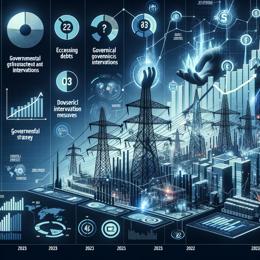
Image created by AI
Independent Report Uncovers Eskom's "Dysfunctional" Management and Preventable Load Shedding
In an impactful revelation, an independent assessment commissioned by the National Treasury has cast a harsh light on Eskom's operational challenges. The report by the VGBE energy association, which scrutinized the utility's coal power stations, was quietly revealed after remaining confidential until 1 March. The assessment was disturbing, highlighting not only Eskom's managerial dysfunction but also the avoidable extreme stages of load shedding that have been plaguing South Africa. In an already burdened economy, these operational inefficiencies hint at staggering annual financial losses, not accounting for the substantial costs of emergency diesel usage.
The VGBE's meticulous analysis points to Eskom's Energy Availability Factor (EAF), which lags significantly behind international standards at a dire 50.83% as of April 2023. This factor measures the capability of energy generation at any given time, factoring in both planned and unplanned outages. Unlike the ideal benchmarks of 78% seen internationally, Eskom's performance is marred by systemic problems in management and overly complex governance structures, as highlighted in the Independent Assessment of Eskom's Operational Situation report handed to Minister Enoch Godongwana in the previous year.
This critical assessment emerged as a consequence of the R254-billion debt relief aid granted to Eskom, carrying the caveat of operational scrutiny. The investigation spanned several crucial areas, including an operational overview of the coal fleet, power plant maintenance budget assessment, personnel skills evaluation, and a transmission grid review, conducted from March to May 2023.
Perhaps the most alarming of the findings was the identification of the potential to eliminate up to six stages of load shedding. This could be realized by merely rectifying existing plant defects and adhering to prudent operation and maintenance standards. These stages of load shedding are not just inconveniences; they depict a significant interruption in economic activity and daily life, with a reported corresponding financial loss of about R152-billion annually due to the current unavailable capacity of roughly 17,419.5MW.
Yet, amidst the gloom, the VGBE report is not without solutions. A clarion call for immediate, stringent interventions has been sounded. They propose empowering on-site power plant management and enlisting an expert team to be situated at each Eskom site for a critical period. This team, reporting directly to the National Treasury, would monitor risk areas and implement necessary intercessions. The experts advocate that with the right resources, and within a rational timeframe, Eskom's plant performance and reliability could see substantial improvements.
In response, the National Treasury acknowledges that some of the recommendations will be integrated into Eskom's 2024/25 Corporate Plan. This gesture hints at a recognition of the deep-seated issues and a willingness to initiate robust reforms.
The VGBE's report raises profound questions about the future of energy supply in South Africa. The need for overhaul is clear, but the pathway is fraught with the challenge of dismantling long-standing managerial inefficiencies and combating systemic issues. For the citizens and economy of South Africa, the stakes could not be higher as the nation grapples with the energy supply that is nothing short of fundamental to its prosperity and well-being.
Leave a Comment
Recent News