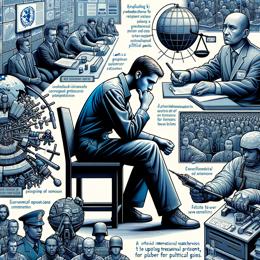
Image created by AI
The Deadly Shadow of the Kremlin: Dissent Equals Danger
The recent sudden demise of Russian lawyer and activist Alexei Navalny has cast a stark light on a disturbing pattern that has long characterized the Russian political landscape. Under the domineering shadow of the Kremlin, dissenters are systematically silenced, often meeting grisly and unexplained ends.
Navalny, who tirelessly worked to expose corruption at the highest levels of the Russian government, fell into a coma in August 2020 after being poisoned with the nerve agent Novichok, an assassination method eerily reminiscent of previous Kremlin-style tactics. While the world watched as Navalny narrowly survived this assassination attempt, his subsequent return to Russia only led to his arrest and later reports of his death under suspicious circumstances, highlighting that Russian dissidents are never truly safe from the Kremlin's reach.
The culture of fear and the suppression of dissent hold firm roots in Russian history, tracing back to the ostentatious House of Romanov and through the iron-fisted rulership of the Bolsheviks. Today, this oppressive legacy continues under Vladimir Putin's regime, where influential leaders disappear without a trace, journalists are routinely murdered, and corporates are swiftly eliminated in what are claimed to be suicides or accidents.
Take for instance Yevgeny Prigozhin, head of the notorious Wagner Group—a paramilitary organization with close Kremlin ties—who met his end in a carefully orchestrated air crash. In a separate chilling incident, Boris Nemtsov, a former deputy prime minister under President Boris Yeltsin and outspoken Putin critic, was gunned down within a dangerously close proximity of the Kremlin.
Reported by The Sydney Morning Herald, the list of elite Russians meeting their ends under mysterious and often violent circumstances has grown to a staggering tally of thirty-two since the advent of the war in Ukraine. The spate of high-profile deaths is not contained within Russia's borders but spans continents, reinforcing a dire warning: dissent against the Kremlin could lead to a death sentence no matter where one resides.
In Putin's Russia, the concept of an "alternative" or room for political opposition is not just frowned upon—it is actively obliterated. The autocratic ruler has demonstrated repeatedly that any form of challenge will be met with the harshest of responses, a gamble that Navalny and many others have tragically lost.
The Kremlin's stark message, underscored by the fate of Alexei Navalny and others, serves as a sobering reminder of the costs of political dissent in Russia. Navlany's story, from his courage in the face of a regime's wrath to his untimely death, is a grim epitome of the Kremlin's unyielding command over life and death.
It remains crucial for the international community to keep a close eye on Russia's human rights record and the ongoing suppression of free speech and political freedom within its borders. A failure to do so not only undermines global values of democracy and human dignity but also emboldens the Kremlin's grip on its citizens, who dare to dream of a different Russia.