Image created by AI
The Education Imperative: South Africa's Road to Equality and Democracy
As South Africans eye the nearing general elections on the 29th of May, amidst the myriad of pressing issues that demand attention, there lies a particularly potent one that may prove pivotal to the nation's future - the state of our education system. Dubbing South Africa "educationally bankrupt" might sound severe, yet it is a distressing diagnosis highlighting the deep-rooted problems plaguing a sector that is the bedrock of a society's growth and the bulwark against its decline.
Despite strides since democracy dawned, with improved access to basic education and the commendable persistence of teachers under arduous conditions, glaring deficiencies remain, casting long shadows on the prospects of achieving genuine equality. The time has come to confront unavoidable questions: How will political parties and candidates address the educational impasse? What are their plans to enhance funding, especially for no-fee schools languishing in poverty-stricken areas?
The notion that education equates to freedom resonates with undiminished relevance. The educated exert agency - they navigate an increasingly convoluted landscape with discernment and thwart the machinations of manipulators. Ignorance, conversely, binds one in invisible shackles, streamlining the populace towards the designs of populist demagogues.
These election campaigns are bereft of robust discourse on education, an ominous omission that speaks volumes. Discernment seems to be the unwanted guest at the political banquet. The chilling assertion by commentator Moeletsi Mbeki some years ago that a less educated electorate might be politically expedient ripples through the current electioneering with unsettling resonance. Is it a mere coincidence that education takes a backseat, or is it a strategic move by those seeking to sustain power through the malleability of the uninformed?
Yet, exemplary international models exist, exemplified by Hong Kong's high-level school on governance and economics that champions the "economy of life," an approach tilting the balance away from exploitative financial systems towards equitable resource distribution. Such initiatives beckon South Africa's youth to forge an ethical and sustainable world.
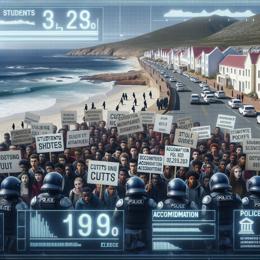
Furthermore, it is not solely upon the state's shoulders that the burden of educational transformation rests. Teachers, by virtue of the esteem granted them in communities, are instrumental in reshaping society. Their role transcends imparting knowledge – it's about activism, about taking a stand alongside civil society to amplify the marginalized voices through protest and peaceful mobilization, embodying the spirit of Paulo Freire's "Pedagogy of the Oppressed".
Education, then, is much more than life's preparation; it is synonymous with life itself. It holds the potential to mould future citizens who embody virtues and informed perspectives, equipped to tackle enduring political and societal challenges. An equitable, peaceable future is contingent on the willingness to reexamine and confront our ingrained assumptions, the very ones that prop up a skewed system of inequality.
The truism that democracy is hollow without the meaningful participation of all voices remains an unassailable pillar of justice. Equality recognizes difference but insists on the equal entitlement to dream and aspire. While this might skirt the edges of idealism, it certainly outshines the grim reality of a society spiraling into poverty and exploitation.
Thus, as South Africa commemorates three decades of democracy, with the elections on the horizon, the imperative to overhaul the education system becomes ever more pressing. It stands as a key to equality and a fundamental precept of democracy - a challenge we must rise to meet.
Leave a Comment
Recent News