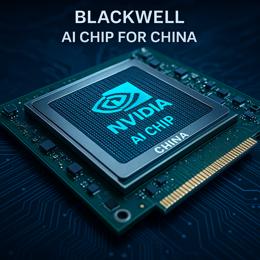
Image created by AI
Nvidia's H100 Chip: The $1 Trillion Game-Changer in AI Innovation
The tech world has been set ablaze by Nvidia's groundbreaking H100 chip, a powerful graphics processor that has transcended traditional gaming uses to become a cornerstone of artificial intelligence (AI) development. This data center dynamo has catapulted Nvidia's market value by more than $1 trillion and crowned it as an uncontested leader in the realm of AI—a sector that is rapidly reshaping the landscape of modern industries.
The H100 chip is a masterpiece of engineering, named in honor of the computing legend Grace Hopper. While its roots lie in enhancing the PC gaming experience, Nvidia's strategic foresight transformed the H100 into an AI virtuoso. It deals with the enormous data processing demands of AI model training, outstripping its predecessor—the A100—fourfold in efficiency and responding to prompts with a staggering thirty-fold speed increase.
Nvidia's story began in 1993 with a vision that parallel processing capabilities would one day extend beyond gaming to broader technological territories. This foresight is now paying dividends. Generative AI platforms—and particularly large language models (LLMs)—thrive on extensive training sessions, digesting vast databases to improve tasks like translation, summary generation, and image synthesis. The H100 chip, therefore, is not merely an enhancement but a critical component that slices through the operational obstacles of AI training.
Santa Clara, California, is where Nvidia's journey of ingenuity continues. With a dominant 80% share of the AI data center market, Nvidia services the computational needs of tech giants such as Amazon's AWS, Google Cloud, and Microsoft Azure. Despite attempts by competitors like Advanced Micro Devices Inc. (AMD) and Intel Corp. to intrude upon this dominance, Nvidia's blend of hardware and tailor-made software, including its proprietary CUDA programming language, has retained its throne.
In sharp contrast to traditional data processors such as Intel's Xeon, the H100 stands tall with an abundance of cores dedicated to AI's data-intensive training process. This capability has propelled Nvidia's data center division to an impressive 81% revenue surge, clocking in $22 billion in the latter part of 2023 alone.
AMD and Intel have not sat idle, with AMD releasing its own AI-focused MI300X chip and Intel working on specific AI-targeted processors. However, their impact on the market has been mild compared to Nvidia's innovation marathon.
Nvidia's success is not just quantified in current achievements but is also echoed in its future plans. With the H200 chip on the horizon and the transformative B100 further down the line, Nvidia's relentless pursuit of excellence ensures its technology remains several steps ahead. CEO Jensen Huang is the company's stalwart champion, urging both government bodies and private enterprises to join the AI revolution or risk being outpaced.
The significance of Nvidia's H100 chip extends beyond mere market statistics or technological marvels—it shapes Nvidia as an ecosystem architect where each customer integration weaves deeper dependencies paving the way for continued business through perpetual upgrades. As the tech landscape evolves, driven by the relentless tide of AI, Nvidia's H100 chip stands as a testament to the company's vision, innovation, and indelible global impact.
#GOOGLE_AD
Leave a Comment
Recent News