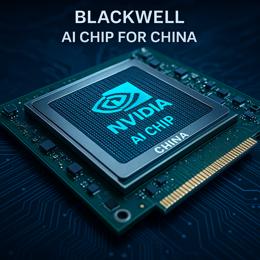
Image created by AI
Nvidia Hits Milestone with Remarkable $24 Billion Revenue Forecast Amid AI Boom
Johannesburg, South Africa – In a groundbreaking development, Nvidia Corp. has once again turned heads with a staggering $24 billion sales forecast, surpassing analysts’ expectations and confirming its leading position in the artificial intelligence (AI) revolution. As Nvidia shares soared by as much as 11% in late trading, the company has illustrated the massive potential of accelerated computing and AI technologies.
According to the statement released on Wednesday, the forecast for the current period draws a sharp contrast with the $21.9 billion average prediction. This bullish outlook follows a fourth quarter that has seen the company's figures voraciously outstrip Wall Street estimates, reinforcing a persistent trend of Nvidia eclipsing market anticipations.
The company’s success can be attributed to the burgeoning demand for its AI accelerators – the silicon brains powering the latest wave of AI models that are transforming how we interact with technology. Recognized for their efficiency in processing large amounts of data, these chips have become essential to the flourishing chatbot and generative AI sectors.
Nvidia's Chief Executive Officer Jensen Huang conveyed a clear message: "Accelerated computing and generative AI have hit the tipping point." He elaborated that the demand for these advanced capabilities is experiencing a worldwide surge, spanning various companies, industries, and nations.
Investors have noted Nvidia's extraordinary ascent. The $1.7 trillion market capitalization represents more than a $400 billion increase within the year, implying strong investor confidence that Nvidia is at the epicenter of an unstoppable AI computing wave.
The company's extraordinary performance has caught the attention of the entire market, setting the stage for a highly anticipated reporting event that not only met but exceeded expectations. The upbeat communications from Huang have invigorated the belief that the robust spending in AI is here to stay.
Competitors and peers in the chipmaking industry, including Advanced Micro Devices Inc., Broadcom Inc., and Marvell Technology Inc., also experienced gains in response to Nvidia’s news, hinting at a broader growth trend in the AI chip market.
Huang, on a conference call, underscored that demand is outpacing supply and is not showing any signs of waning. He projected that such voracious appetites for Nvidia products could lead to a doubling of the global data center installations in five years, potentially signaling an annual market opulence in the hundreds of billions.
Nvidia, known initially for its gaming graphics cards, has seen its prominence soar in recent years as its technology adeptly manages demanding AI workloads. The H100 accelerators, Nvidia's pride, have become nearly mythical in tech circles, coveted by companies looking to capitalize on advanced AI capabilities.
The company's impressive client roster includes tech juggernauts like Amazon.com Inc., Meta Platforms Inc., Microsoft Corp., and Alphabet Inc.’s Google. These companies collectively comprise nearly 40% of Nvidia’s revenue, each racing to bolster their hardware for next-level AI computation.
Reflecting on Nvidia’s phenomenal growth, the fiscal fourth quarter ending January 28 saw the company’s revenue more than triple to $22.1 billion, with earnings at $5.16 a share, notably higher than the sales of $20.4 billion and earnings of $4.60 a share anticipated by analysts.
The data center segment, the powerhouse of Nvidia’s sales, chalked up $18.4 billion in revenue – a stunning increase of 409% compared to the previous year. Gaming chips contributed a hefty $2.87 billion in sales, further demonstrating Nvidia’s diverse strengths.
Looking ahead, Nvidia has been forging partnerships to expand the reach of its AI technology. A recent deal with Cisco Systems Inc. aims to escalate the deployment of AI systems across various corporations, tapping into a new distribution channel.
Despite its substantial growth, Nvidia is facing competition, ever-evolving customer needs, and export challenges, particularly with new regulations concerning trade with China. However, Huang remains optimistic and ready to adapt, indicating that the company is sending new, restriction-compliant chip samples to Chinese customers, potentially reigniting growth in a critical market.
#GOOGLE_AD
Leave a Comment
Recent News