Image created by AI
Texas Company Intuitive Machines Set To Land On The Moon, Pioneering Private Lunar Touchdown
In an unprecedented event for US industry, Intuitive Machines, a company hailing from Texas, is on the brink of achieving what has been the sole forte of national space agencies - landing on the moon. This significant endeavor, if successful, will demonstrate the burgeoning capabilities of private space firms and could inaugurate an era where moon landings become a more frequent enterprise by commercial entities.
The Houston-based company's spacecraft, christened 'Odysseus,' is set for a delicate landing in the vicinity of the moon's south pole on Thursday at precisely 2249 GMT. This ambitious undertaking not only holds promise for Intuitive Machines but also serves a higher purpose, contributing to NASA's expansive plans for human re-exploration of the lunar surface later this decade.
The stakes are considerably high, especially following the disappointment experienced by a different US firm last month, whose lunar aspirations culminated in failure. This current mission carries the hopes of establishing the notion that private industry possesses the technological and operational finesse required to anchor an American lander on the moon for the first time since the epochal Apollo missions.
Intuitive Machines' CEO, Steve Altemus, emphasized the necessity for the private sector to embrace risks while addressing the United States' call to return to our natural satellite. This mission is not a stand-alone venture but a collective endeavor to revisit the moon after a 52-year intermission.
In line with the need for transparency and public engagement, Intuitive Machines is planning to broadcast the landing live on its website. The earthbound audience can expect a confirmation from the flight controllers roughly 15 seconds after the historic event.
As 'Odysseus' descends, it will deploy an "EagleCam," designed to capture the lander's final seconds before touchdown—a remarkable spectacle guaranteed to garner significant interest.
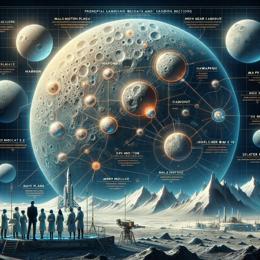
Odysseus, akin in size to a large golf cart and hexagonal, launched on a SpaceX Falcon 9 rocket on February 15. The spacecraft's innovative supercooled liquid oxygen and liquid methane propulsion systems facilitated a speedy transit through space, capturing Earth's images along the route. Its target, the impact crater Malapert A, lies about 300 kilometers from the lunar south pole, an area of significant interest for NASA.
Under the Artemis program, NASA has high ambitions for this locale, envisioning a sustainable human presence and utilizing the moon's resources such as ice for drinking and as a source of rocket fuel. To foster these long-term objectives, NASA has invested $118 million in Intuitive Machines for delivering and operating scientific hardware essential for human habitation's environmental implications.
The equipment carried by Odysseus includes cameras and devices to study the moon's ephemeral phenomena, such as how the lunar surface reacts to spacecraft landings and the peculiar dust clouds that form due to solar radiation. These experiments are poised to yield data for approximately seven days until the lunar night envelops the pole, cutting off solar power and concluding the mission's active phase.
Known as IM-1, this mission is one of several under NASA's Commercial Lunar Payload Services (CLPS) program, which has been crafted to outsource cargo deliveries to private companies, thereby achieving cost savings and promoting a more extensive lunar economy. 2024 is shaping up to be an especially busy year for the moon, with four more CLPS missions scheduled to take place.
However, lunar landings are fraught with challenges, from navigating potentially perilous terrain to executing a controlled descent without the assistance of an atmosphere requisite for parachutes. Of the 50-plus attempts over the years, approximately half have failed.
Adventures to the lunar surface began with the Soviet Union's Luna 9 in 1966, followed by the United States, which remains the only nation to have manned landings to its credit. In the race to explore the moon, China, India, and Japan have marked their presence, with India landing just this year.
If Intuitive Machines' voyage culminates in success, it shall represent a watershed moment for private sector spaceflight and lay the groundwork for the future exploration and utilization of our nearest celestial neighbor.
Leave a Comment
Recent News