Image created by AI
South Africans Rally Against Live Animal Export Amid Cape Town Odour Woes
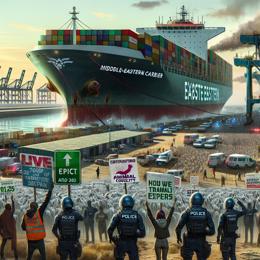
The rising dissent in Cape Town over the shipping of live farm animals is reaching a critical point, as more than 74,000 locals have lodged a plea against the continued practice, a figure reflecting a significantly engaged citizenry on the issue of animal welfare. In the eye of the storm is the 'Al Kuwait,' a vessel currently berthed in Cape Town's harbour, causing residents in neighborhoods like Woodstock and the CBD to complain about a pervasive sewage-like smell. But the public outcry extends beyond the unpleasant odour to the core ethical treatment of exported livestock.
In a recently issued statement, Toni Brockhoven, the chairperson at Beauty Without Cruelty South Africa (BWC), voiced the organisation's strong opposition to the live export of farm animals. BWC argues that South Africa's robust agricultural sector, seen as a national asset, should not be grown or sustained through practices that violate the nation’s Constitutional principles or the rulings of its courts. Such practices are in question with the perpetual undertakings of ships like 'Al Kuwait' at the nation's ports.
Brockhoven insists that the Department of Agriculture, Land Reform and Rural Development (DALRRD) must critically reassess its stance on live animal exports. Following this line of thought, BWC advocates for the live exports to be replaced with a process where animals are slaughtered on home soil, in line with the Islamic halaal prerequisites, at designated export abattoirs.
Halaal slaughtering practices, as detailed by Shaykh Achmat Sedick of the Muslim Judicial Council Halaal Trust, require that animals are treated wholesomely and humanely ('tay-yib') prior to slaughter, which includes adequate rest and access to fresh food and water. The physical and psychological well-being of the animals at slaughter is paramount, with the Islamic laws on treatment brokering no cruelty or stress.
However, the narrative is not just one of religion and ethics. From an economic perspective, BWC holds that the export of processed meats could be more profitable than the current live export business model, allowing the South African economy to benefit from added value, while also ensuring ethical practices.
The 'Al Kuwait's presence is not inconsequential. Having arrived from Brazil, its stopover in Cape Town involves stocking up on animal feed before continuing to the Middle East. Transnet National Ports Authority anticipates its departure by February 20, 2024. Meanwhile, the SPCA has been involved, inspecting the conditions of animals on board, and investigations into the full impact of the ship's activities continue.
As the dialogue intensifies, the confluence of ethical discourse, economic reasoning, and social activism showcases a community not just striving for environmental justice but also advocating for animal welfare. This passionate collective call to action is a clear indication of the tides of change, as the nation's people demand practices that align with South Africa's Constitutional mandate for the compassionate treatment of animals.
Leave a Comment
Recent News