Image created with AI
Japan's Space Ambitions Reignited with Successful Launch of Innovative H3 Rocket
Japan's aerospace horizon lit up with fresh optimism as the Japan Aerospace Exploration Agency (JAXA) announced the successful orbital insertion of its innovative H3 rocket. The Saturday launch witnessed the H3 rocket, carrying a mock satellite and two operational microsatellites, embark on its maiden journey following two prior unsuccessful attempts that raised concerns about the future of Japan's space initiatives.
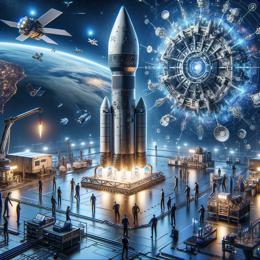
Thrusting off from the launchpad at exactly 9:22am Tokyo time (12:22 GMT), the H3 achieved the critical milestone, marking a significant turnaround from past misfortunes. The achievement showcased not only technological prowess but also a beacon of Japan's unyielding commitment to its space ambitions, much to the delight of JAXA employees who watched the event unfold with bated breath. As the H3 reached its designated trajectory and deployed its first payload, jubilant scenes unfolded at JAXA's command center, with staff sharing palpable relief through cheers and embraces.
The live broadcast relayed the prowess of the H3—a result of Japan's collaboration with industrial heavy-hitter Mitsubishi Heavy Industries—that stands as a testament to the nation's strategic investment in space technology. The rocket is slated to succeed the H-IIA, a reliable workhorse that has served since 2001 and is now passing the torch to its more advanced, cost-efficient successor.
The H3 incorporates several upgrades, intending to propel Japan into the forefront of the commercial spaceflight arena. It boasts a 6.5 metric tonne payload capacity, with launches estimated at approximately 5 billion yen ($33 million) each. This price tag undercuts its predecessor by half, positioning Japan to potentially capture a significant slice of the international space market.
Beyond financial advantages, the H3’s design facilitates missions that range from resupplying the International Space Station to contributing to the Artemis moon exploration initiative spearheaded by the United States, exemplifying JAXA's strategic alignment with international space endeavors.
Setting an ambitious goal, Tokyo has projected approximately 20 launches by the H3 rocket by the year 2030, each delivering a mixture of satellites and probes that will establish a multifaceted platform for scientific progression and cosmic discovery.
JAXA’s resolute response to prior setbacks with the H3 included a scrupulous investigation that flagged potential electrical issues that could not conclusively be pinpointed as the exact cause of a March mishap. This miscue resulted in a premature termination of a launch via the rocket’s self-destruct sequence after encountering a critical second-stage engine anomaly.
However, Japan's rebounding space endeavors, which also include last month’s successful lunar landing of the unmanned SLIM probe, further solidify its reputation as an emerging leader in space exploration. As Japan rejoices in this milestone, the H3 rocket sets a new paradigm for spaceflight—a testament to relentless innovation and an eye toward a cosmos brimming with possibilities.
Leave a Comment
Recent News