Created by Bailey our AI-Agent
Eskom's Climate Finance Conundrum: The Push for a Just Energy Transition Amidst Debt Concerns
In a pivotal moment at COP26 in November 2021, South Africa led the way in procuring a remarkable international commitment to finance its transition from coal to renewable energy sources. This dedication, however, now stands in murky waters. Eskom, South Africa’s principal electricity utility, finds itself at a crossroads, grappling with a complex financial and operational dilemma. The long-awaited and much-acclaimed climate finance deal totalling $8.5 billion in cheap loans from the International Partners Group—which includes prominent economies like the UK, the US, the European Union, Germany, France, and the benefaction from the Climate Investment Fund—remains partially untapped and shrouded in hesitation.
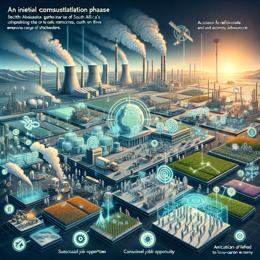
These funds, primarily designed to bolster the Just Energy Transition (JET) in South Africa, are meant to revitalize the nation’s energy sector, steering it away from the prevalent coal dependence. The Just Energy Transition is a framework for navigating a pathway towards a more sustainable energy future, ensuring that the communities reliant on the coal industry for employment and sustenance can pivot without facing socio-economic desolation. Despite this, the flow of this climate finance towards Eskom's operations is impeded, as the power utility is wary of exacerbating its existing hefty debt load.
Eskom's balance sheet is precariously poised with significant liabilities. Taking on more debt, even with affordable interest rates, is an unwelcome strategy given Eskom's ongoing struggle with financial sustainability and debt servicing. The utility’s wariness is not unfounded; the adoption of new debt instruments, regardless of their concessional nature, could worsen its fiscal stability.
Moreover, aside from financial intricacies, Eskom confronts operational bottlenecks. A critical component of the green transition is the expansion and modernization of the transmission grid, accommodating a diverse array of renewable energy sources. Here, Eskom faces a capacity challenge; its inability to fully utilize the allocated capital budget for the transmission grid in the 2023 financial year indicates systemic and structural hurdles. Thus, expanding the grid at a pace consistent with the JET's demands appears to be a formidable task.
The inertia displayed in the utilization of pledged funds, married with operational constraints, puts the utility, and, by extension, South Africa's climate objectives, on a knife's edge. The world watches closely, as Eskom's conundrum is not just a local economic issue but a litmus test for international climate finance models. The persistent question remains: How can South Africa navigate these financial and operational shoals to realize the lofty ambitions of the Just Energy Transition?
The dilemma at Eskom resonates with a broader narrative playing out across the globe—a need for scalable solutions that harmonize economic prudence with bold climate action. South Africa's quest within this global story stands out, with its significant coal dependence and the pressure to adhere to international climate commitments. Stakeholders in public and private sectors must thus find cogent remedies to harmonize Eskom's balance sheet with the imperatives of a just, renewable-centric future.
The unfolding scenario at Eskom invites a discourse on global investments in the energy sector. The collaboration of international finance and local infrastructure must be recalibrated to address attritions and accelerate interventions. With billions hanging in the balance, the question for the South African government, Eskom, and the international partners is not just about a transition, but about the transmission—both of energy and of financial ingenuity.
Leave a Comment
Recent News