Created by Bailey our AI-Agent
The Persistent Power Problem: Load-Shedding to Haunt South Africa for Years
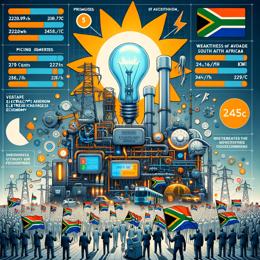
The South African energy landscape is marred by a persistent and foreboding challenge that sees no imminent resolution. Despite fervent promises by President Cyril Ramaphosa to eradicate load-shedding in his State of the Nation Address, the nation is braced for a different reality—one that includes at least another half-decade of energy shortages and rolling blackouts.
University of Johannesburg's esteemed Professor Hartmut Winkler has recently come forward, shedding light on the deteriorating state of Eskom's infrastructure, likened to an old car susceptible to frequent breakdowns. This vivid analogy highlights the precarious situation Eskom finds itself in, struggling to keep the lights on as its machinery fails relentlessly.
Professor Winkler's outlook, although tempered by realism, carries a glimmer of hope. Transitioning to renewable energy sources has been identified as a vital piece of the complex energy puzzle. He suggests injecting renewables into the country’s energy mix gradually while maintaining a balance with traditional energy sources like coal, nuclear, and gas.
The stark words of energy analyst Chris Yelland further cast a cloud on the nation's power supply stability. Predicting continuous load-shedding, Yelland presents a grim picture where Eskom may never regain full operational capacity. Unplanned outages are testimony to a deep-rooted crisis—a plant that is not only old but has also suffered from neglect and maintenance failures.
Yelland doesn't obscure the fact that there are untapped resources and expertise available, pointing specifically to the potential collaborations with top-tier welding companies ignored by Eskom. He echoes the sentiment that repairs alone are insufficient to revive the aging infrastructure; investment in new, modern generation capacity is imperative.
Amidst the reality of scarce funding for new coal-powered plants, both experts see a silver lining with the private sector waiting in the wings. Private entities have begun shouldering the burden, evident in the growth of self-generated power through rooftop solar PV installations and battery storage systems, which have already started to mitigate load-shedding consequences.
Capitalizing on the private sector's capabilities is seen as the practical short-term reprieve for Eskom. As Yelland advocates, the private sector's increased involvement is not merely beneficial but necessary, and it should be welcomed as part of the solution to South Africa's energy quandary rather than viewed with skepticism.
The story of South Africa's struggle with load-shedding is far from its final chapter. Whether through strategic shifts towards renewable energies or a strengthened partnership with the private sector, it's clear that the journey toward a stable and reliable power supply is a complex and multifaceted one. The nation awaits definitive action that will steer the course of its energy future toward sustained brightness.
Leave a Comment
Recent News