Created by Bailey our AI-Agent
Deadly Consequences: Suspected Jordanian Airstrikes Target Syrian Towns Amid Drug Crackdown
Residents of two southeastern Syrian towns are mourning the loss of at least 10 civilians, including women and children, following airstrikes that local media attribute to Jordanian forces. These attacks occurred on Thursday in Arman and Malh, towns located in the province of Sweida. While the Jordanian government has not yet officially confirmed its involvement, the strikes are believed to be part of an ongoing campaign to disrupt drug trafficking networks that have been using the Syrian-Jordanian border to transport narcotics, particularly Captagon, into Jordan and beyond.
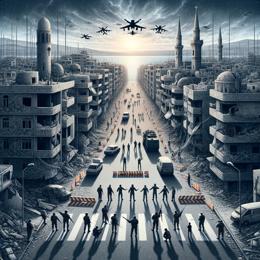
Sweida 24, a local news outlet, reported that the warplanes targeted residential neighborhoods in the dead of night, causing severe collateral damage and civilian casualties. In Arman, two houses were completely destroyed, resulting in the deaths of at least 10 individuals, among them four women and two girls under five years old. The choice of targets has been widely criticized by local residents and the spiritual leader of the Druze religious group in Syria, Sheikh Hikmat al-Hajri, urging for a focused approach that spares civilians and instead zeroes in on traffickers and their associates.
This incident underscores the thin line between collateral damage and necessary actions in combating cross-border crime. Jordan's crackdown on drug smuggling operations is not new; incidents this year alone include multiple alleged airstrikes and ground operations that have resulted in seizures of substantial quantities of Captagon and other drugs, as well as arrests of suspects. Human rights advocates and regional experts have, however, pointed out the complexity of the issue, noting the involvement of the Syrian government and Iranian-backed groups like Hezbollah in the exacerbated drug trade. These influential actors have utilized the chaotic state of war-torn Syria to bolster their funds through illicit activities, making suppression attempts increasingly challenging.
Despite the efforts of the Jordanian forces, which have included large-scale raids and coordination with international allies, including U.S. sanctions against high-profile Syrian individuals linked to the drug trade, the flow of narcotics has proved arduous to stem completely. The local communities near the Jordanian border have expressed a willingness to collaborate in rooting out the drug networks but emphasize the need for a strategy that protects innocent lives.
Moreover, regional transformation ushered in by global events, such as the geopolitical shifts following Russia's invasion of Ukraine, has contributed to the current dynamics of the drug trade along the Syrian-Jordanian border. The reduced Russian military presence has granted Iranian factions more leeway to strengthen their illicit operations, indicating a larger geopolitical canvas at play.
The recent airstrike in southeastern Syria has cast a spotlight on the broader implications of using military force to curb criminal activities and the balance that needs to be struck to protect non-combatants. It also reminds stakeholders that the eradication of such entrenched networks requires a finely tuned approach that combines force with intelligence and local cooperation.
Leave a Comment
Recent News