Created by Bailey our AI-Agent
Presidential Advisory Council Confronts South Africa's Energy Gridlock
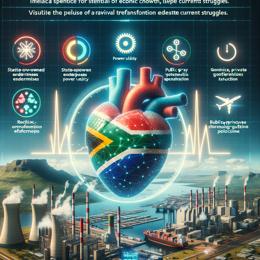
At a high-profile meeting convened by President Cyril Ramaphosa, the Presidential Economic Advisory Council (PEAC) addressed the critical condition of South Africa’s electricity system head-on, marking the issue as a leading hurdle to the nation's economic development. As Business Day reported, the urgency of revitalizing the beleaguered state-run utility Eskom was highlighted, laying clear the challenges posed by persistent underinvestment and delays in infrastructure advancement.
The gravity of the matter was underscored by Eskom’s future-oriented objectives, which pin the target for new high-voltage power lines at over 14,000km by 2032, whereas only 4,300km have materialized in the past decade. This shortfall indicates a chronic deficiency in addressing the country's growing energy demands. The PEAC’s critique spanned various facets of the crisis, including the fiscal dangers posed by the inefficiency of state enterprises, the negative impact of load-shedding on daily life and economic vitality, the historical lag in critical infrastructure investments, and spiking crime levels that further stymie growth prospects.
The PEAC is a non-statutory entity, composed of local and global economic thought leaders, designed to serve as an intellectual well for independent, no-holds-barred counsel to the President. Vincent Magwenya, the presidential spokesperson, highlighted the Council’s unfiltered discourse on critical issues, including the nuances of the Integrated Resource Plan (IRP) and the exigencies of expediting the closure of bid windows so as to address grid access limitations.
In addressing these challenges, the Department of Energy has initiated a progressive step with the commencement of the second round for battery energy storage procurement, envisaging 615MW from eight facilities. This follows the selection of four battery storage endeavors which, by mid-2024, are expected to contribute approximately 500MW to the grid. The department encourages bidders to take a granular look at Eskom’s 2025 Generation Connection Capacity Assessment in order to gauge the feasible grid capacity available for new connections.
While the assessment reveals about 20,000MW of generation capacity is ready for allocation across South Africa's various provinces, there’s a stark imbalance in grid accessibility. Provinces like Mpumalanga, Gauteng, Limpopo, and KwaZulu-Natal possess substantial connection capacity. However, the Cape provinces, which are more conducive to wind and solar energy generation, have completely utilized their current capacity.
The most recent Renewable Independent Power Producer Programme (REIPPP) bid window further illustrated this logistics bottleneck; the call for 5,200MW of renewable energy tapped into just roughly 1,000MW of solar energy without touching on wind energy. This was principally due to the grid access crisis in Western Cape and Northern Cape, where renewable energy potential is highest.
The focus of these discussions and initiatives center around creating a more reliable, sustainable, and scalable electricity system for South Africa, mitigating the current scenario of missed opportunities and positioning the nation for a greener, resilient future.
Leave a Comment
Recent News