Content created by Bailey our AI journalist
Eskom's Challenging Transition: The Surge in Rooftop Solar and Its Financial Implications
Amidst ongoing power challenges in South Africa, Eskom, the primary electricity utility company, is grappling with a significant transition. The widespread adoption of home solar systems is reshaping the country's energy landscape, with Eskom's customer base shrinking rapidly.
Recent data showcases the monumental shift, reflecting a year-on-year doubling in solar photovoltaic (PV) installations on commercial and residential properties – jumping from 2.4 gigawatt peak (GWp) to a staggering 5.04GWp. The financial implications of this exodus are dire, with an energy expert predicting revenue losses nearing R80 billion for Eskom.
Professor Willie Cronje of the University of Witwatersrand points out the current surplus in Eskom's generation capacity masks the gravity of revenue loss— an issue that may come to the fore as this capacity decreases.
Furthermore, the economic verdict by Tshepo Kgadima, an independent energy analyst, is grim. Eskom's power sales have plummeted from 193 to 160 terawatt-hours. This decrease, coupled with increasing tariffs and Eskom's load shedding strategy, induces a quicker shift from grid dependence to solar. Kgadima underscores how solar batteries— charged during sunlight hours—curtail demand for Eskom's supply, even outside load shedding periods.
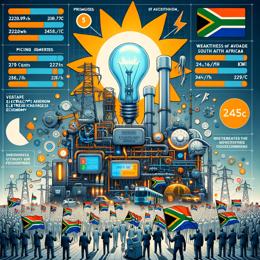
The financial strain on Eskom is amplified by the logic of costs. The National Energy Regulator of South Africa (NERSA) sanctioned a tariff of R2.18 per kilowatt-hour, but, as per Kgadima, it's now cheaper to operate off-grid at rates under R1.60 per kilowatt-hour. This presents a no-brainer for consumers, propelling them towards self-sufficiency and further financial deprivation for the utility.
Counterintuitively, energy analyst Lungile Mashele presents a nuanced landscape—while there's an uptick in solar usage, a complete disconnection from Eskom is rare. The majority of solar adopters still lean on the utility during evening hours.
The geographical distribution of solar adoption is unequal. The surge is most prominent in the Western Cape with a tripling of installed capacity, while Gauteng's growth remains the least significant among provinces—despite possessing the highest capacity. This indicates varying degrees of financial or ecological motivation across provinces.
The private sector's current rooftop solar capacity is approaching thrice that of the government's Renewable Energy Independent Power Producer Procurement Programme. Eskom has turned to data analytics to understand this trend, correlating energy consumption changes to solar installation rates. Rooftop solar, therefore, serves a dual purpose—augmenting the grid's capacity and evening out peak demands, especially in residential spaces where solar-stored energy slashes nighttime demand significantly.
This migration to self-generated solar energy marks a key point in South Africa's energy consumption narrative. Eskom, a company once monopolizing power provision, is now at a crossroads, needing to reimagine its role and financial structure in light of the renewable revolution.
Leave a Comment
Recent News