Content created by AI
South Africa's Electricity Grid Innovations: Private Investment without Ownership
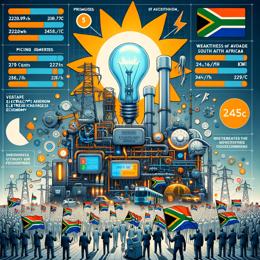
South Africa's electricity landscape is on the brink of arguably its biggest change in decades as Minister of Electricity Kgosientsho Ramokgopa has hinted at a new financing model for the country’s ailing transmission infrastructure. This model could involve private investment without transferring ownership from Eskom, the national power utility plagued by fiscal and operational challenges.
With record levels of load shedding in 2023 and bleak projections for the following year, there’s an urgent call to improve the country’s energy stability. The new finance plan for transmission lines is part of a broader strategic move to alleviate the current energy crisis and to pave the way for further generation projects that could see South Africa meet its future electricity demands.
Ramokgopa, in a briefing, indicated that the procedure for the financing plan's announcement was set in motion through a Memorandum of Understanding alongside Minister of Public Enterprises Pravin Gordhan. This strategic agreement highlights the need for a more streamlined, effective focus on the country’s electricity transmission needs. The memorandum enables enhanced coordination between government divisions and sets the stage for the introduction of innovative financing models in collaboration with the National Treasury and the Presidency.
The plan, though facing some adjustments, envisions the expeditious expansion of the grid. Eskom's Transmission Development Plan, which outlines 14,000km of new lines to be implemented over the next decade, has set an accelerated timeframe looking at halving the initial timeline. The plan seeks to leverage private sector liquidity without compromising Eskom’s ownership, aligning with National Treasury's vision for a fiscal strategy that does not overly burden the sovereign with guarantees.
Notably, the formation of a "dedicated body" to enter into finance contracts has been proposed to cut through the red tape that currently hinders swift governmental action.
Concurrently, Eskom has announced the appointment of a board for the National Transmission Company of South Africa (NTCSA), with Priscillah Mabelane leading the way. The NTCSA is a new subsidiary under Eskom's unbundling plan, which is a critical component of restructuring Eskom into separate entities focused on generation, transmission, and distribution—each with its own operational and financial responsibilities.
Despite its innovations, the proposal has already sparked debate among investors and the broader public, centering on the viability of investing in infrastructure without ownership control. Critics question the attractiveness of the investment without direct management or profit potential. Moreover, there are concerns about Eskom's ongoing issues with corruption and inefficiency which might pose risks to potential private investors.
However, the belief that only the private sector has the acumen to transform South Africa’s energy grid underscores this discourse. By tapping into private investment for transmission infrastructure, South Africa could be taking the first step towards a more resilient and reliable electric system—one where Eskom could benefit from private sector efficiency while maintaining control over national energy assets.
The ultimate goal of this seismic shift in South Africa’s electricity sector is to create a grid that is capable of supporting new generation capacity, encouraging the government to partner with industries and communities toward a more sustainable energy future.
Leave a Comment
Recent News