Content created by AI
South Africa's Energy Paradox: Renewable Rich Capes Clash with Grid Capacity Constraints
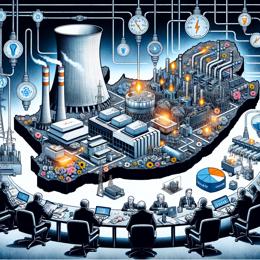
South Africa's ambition to transition towards cleaner energy sources could be facing a critical bottleneck, as the country's power grid, operated by the state-owned electricity public utility, Eskom, struggles to integrate the surge in private renewable generation projects. In a detailed analysis by Eskom's Generation Connection Capacity Assessment of the 2025 Transmission Network, stark revelations emerged about the incapacity of the Eastern, Western, and Northern Cape's grids to accommodate new generation projects, despite their rich renewable resources.
The structure of South Africa's power grid, historically engineered to distribute electricity from large, centralized power stations situated predominantly in the northeast, is failing to cope with the distributed nature of renewable energy generation. This has led to a situation where the renewable-rich regions like the Capes lack the necessary infrastructure to transport produced energy to where it's needed most in the country.
Monique Le Roux, chief engineer at Stellenbosch University’s Centre for Renewable and Sustainable Energy Studies, highlighted the severity of the challenge earlier this year. She cautioned that if Eskom fails to upgrade the grid to handle this rapid growth in renewables, particularly solar, we could see provincial transmission lines overwhelmed and potentially damaged by operation at peak capacities.
In response, Eskom has drafted an ambitious transmission development plan, which sees the construction of 14,000 km of new transmission lines over the next ten years, at an estimated cost of R372 billion. However, with the private sector's accelerated renewable energy projects deployment in grid-constrained areas, the utility's financial requirement has risen—anticipating an additional R100 billion in 2025 that will escalate to R170 billion by 2029.
The geographical misalignment of generation versus transmission capabilities further complicates the issue. The Cape provinces, rich in renewable resources, are poorly connected compared to the well infrastructured northeast. Mark Swilling, an expert in sustainable development, notes a potential energy landscape transformation where, over the next 20 years, South Africa might witness a 180° flip in its grid structure, with generation shifting towards the Capes.
This transformation requires a pace of infrastructure development that far exceeds current efforts. To match the necessary grid reversals, South Africa would need to erect 2,300 km of transmission lines each year, a target that starkly overshadows the present 400 km annual production of lines and even surpasses the maximum of 1,800 km achieved in the 1990s.
With such a colossal task ahead, the sustainable and economic future of South Africa's energy sector hangs in a delicate balance. The nation now stands at a crossroads, with the path elected to resolve this grid conundrum potentially defining its role as a leader in the renewable transition within the African continent.
Leave a Comment
Recent News