Content created by AI
Uproar in Luton: Student Protests Highlight Tension Over UK Educational Institutions' Ties to Arms Trade
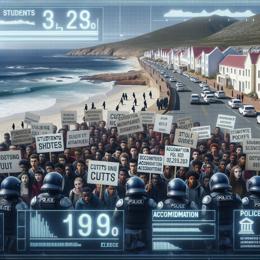
In a display of youthful activism and solidarity, students at Luton Sixth Form College staged a walkout to draw attention to an issue that ties their educational institution to the broader geopolitical landscape. The controversy arises from the discovery that their college had been engaged with the arms company Leonardo, known for supplying military equipment to Israel, a nation mired in conflict with Gaza.
The student-initiated protest reflects a growing concern among British youth regarding the partnerships their educational institutions establish and the ethics underpinning them. The Luton Sixth Form College's student council, a body representing over 3,000 students, originally sought a more peaceful mode of engagement by proposing a fundraiser to support victims of the conflict. However, their proposals were met with resistance, leading to the more direct action of the walkout.
Such student activism is far from isolated — across the UK, there has been a resurgence of student protests which underscore a refusal to remain passive in the face of perceived injustices. However, the repercussions faced by the student council at Luton Sixth Form College, which include disbandment and suspension of their official means of communication, have raised questions about the freedom of speech and the space for dissent within British educational institutions.
The response of the college and its silence regarding the relationship with Leonardo prior to the walkout suggests a reluctance to address the concerns raised by students openly. This reluctance, combined with the subsequent punitive measures, stands in contrast to British values that champions democratic participation and free expression.
Simultaneously, another dimension to the protest has emerged. Shout Out UK's scheduled workshops at the college — an organization associated with government programs such as Prevent that aim to counter extremism — have inadvertently added fuel to the fire. The placement of these workshops in the context of the protest has further intensified student concerns over the encroachment of freedom of speech within the educational realm, especially in relation to pro-Palestine advocacy.
With a growing number of student-led actions across the country, it is becoming clear that there is a larger trend at play: a clash between the principles of education as an enabler of critical engagement, and the institutional mechanisms that see such engagements as threats.
The incident at Luton Sixth Form College serves as a microcosm of the tension that exists between expression and authority. It invites a reexamination of how educational institutions can navigate their relationships with external entities, particularly those involved in contentious industries like arms trade, without compromising the values of their student communities.
In the face of student walkouts, suspensions, and continued dialogues about education's place in broader social issues, one thing remains clear: the students have sparked an important conversation. A conversation on the right to protest, the right to engage with complex international issues, and the extent to which educational environments should be a reflection of corporate interests or societal values.
Leave a Comment
Recent News