Content created by AI
South Africa's Healthcare Quagmire: A Tale of Policy Success and Execution Failure
South Africa's Department of Health faces an array of deep-rooted issues marked by systemic inefficiency, staff shortages, weak leadership, and governance failures, resulting in its grading plummeting to an 'F'. The ruling African National Congress (ANC) has made strides in dismantling racially based, uneven healthcare access by doubling primary healthcare spending and significantly improving immunization coverage. Yet, stumbling blocks in leadership and oversight persist.
Over 20 to 30 years, multiple academic studies and expert interviews suggest that policy advancements often saw poor implementation. The country, grappling with a triple disease burden and one of the highest global inequality indices, has transitioned from the dark days of AIDS denialism to a commendable, extensive antiretroviral treatment program. Around nine million South Africans live with HIV, with a substantial number receiving treatment, mitigating the disease to a chronic status contingent on drug adherence.
Progress in combating TB, the nation's leading cause of death after diabetes, includes better detection, treatment adherence, and the advent of new drugs. The health crisis extends to diseases of poverty, infectious diseases, and a surge in non-communicable diseases. Praise is due to South Africa's formidable researchers, academics, clinicians, and NGOs leading TB and HIV intervention efforts.
Some legislations under the ANC era, like anti-tobacco laws and attempts to curb high-sugar foods, have been forward-moving but inadequately enforced. Likewise, the National Health Act, initiated amidst the tumultuous AIDS denialism period, institutionalized a district health system key to primary healthcare delivery but has faced implementation hurdles.
The government's ambitious National Health Insurance (NHI) scheme aims to equalize healthcare access, but burgeoning debate stirs around its feasibility and constitutionality. With the National Council of Provinces passing the NHI bill, which business leaders and health professionals describe as "unworkable" and "unconstitutional," a constitutional court battle looms on the horizon.
South Africa's 2020 lockdown, induced by the Covid-19 pandemic, disrupted healthcare service delivery and drug adherence dramatically. Laetitia Rispel from Wits University points out the country's health sector transformation woes: tolerance of incompetence, ineffective leadership, and governance failures, intensified by corruption and labor disputes.
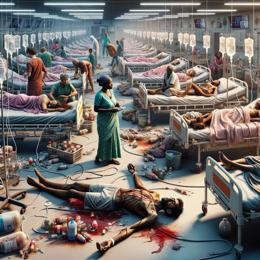
Allegations of opportunistic corruption lead to health minister Zweli Mkhize's resignation, while conflict in the ANC-affiliated tripartite alliance exacerbates these issues. Poor district health execution and a health workforce crisis compound problems, resulting in subpar patient experiences and overburdened, demoralized frontline healthcare providers.
Some hope was pinned on the Office of Health Standards Compliance for regulation, but it too was reduced to a monitoring role without substantial authority. Experts argue that the OHSC's power structure—replicated in the NHI legislation—underscores the absence of lessons learned from past experiences.
Covid-19 further exposed the health workforce crisis, plunging early-career healthcare professionals into dilemmatic conditions, with many seeking opportunities abroad due to lack of support and placements.
The broader fiscal landscape complicates matters, with dwindling budgets and a ballooning balance of payments deficit contributing to the strained healthcare system. South Africa spends roughly 9% of its GDP on healthcare with underwhelming outcomes compared to nations that invest less.
Rispel suggests boosting department stewardship, enhancing data-driven decision-making, and insisting on national leadership accountability. Health ombud Malegapuru William Makgoba chronicles abysmal service delivery across most provinces, attributing it to weak leadership, infrastructural decay, and staff shortages.
Importantly, the growing private health sector since 1994 counters public health interests, with the 2019 Health Market Inquiry decrying competitive malpractices too late to reverse the tide. South Africa teeters on the precipice of health policy and delivery overhaul amidst economic and structural tumult.