Content created by AI
The Trial of Jimmy Lai: The Intersection of Law and Freedom of Expression in Hong Kong
In a landmark case that has reverberated across the international community, Hong Kong media tycoon Jimmy Lai commenced his trial under the contentious national security law. Lai, a prominent figure in the pro-democracy movement and an ardent critic of the Chinese government, stands accused of colluding with foreign forces, an offense that threatens the very core of press freedom and freedom of expression in the territory.
Jimmy Lai, who turned 76 while in custody, has been imprisoned since December 2020, and his presence in court marked the culmination of tensions that have been brewing since the national security law was imposed by Beijing in June 2020. His charge sheet extends to allegations under a sedition law that harks back to the British colonial period, and despite his consistent pleas of not guilty, he has faced significant hurdles in his defense, including interventions regarding his legal representation.
The trial's ramifications extend far beyond the courtroom. On the international front, UK Foreign Secretary David Cameron joined the United States and European Union in denouncing the trial and advocating for Lai's immediate release. The security law, according to detractors, violates the guarantees made to Hong Kong upon the handover in 1997, with Cameron calling for its repeal and the release of all charged under its auspices.
The trial has underscored a deepening crackdown on Hong Kong's previously vibrant civil society and free press, all of which originated from the large-scale pro-democracy protests in 2019. These protests, which initially erupted over an extradition bill, rapidly evolved into a broader call for democratic autonomy. Amnesty International has denounced the drastic impact of the national security law on human rights in the region, stating that it has "decimated" the freedoms that once defined the semi-autonomous city.
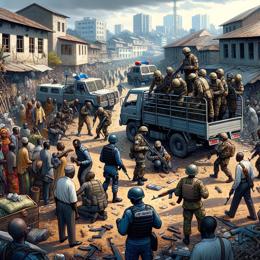
Security was visibly heightened at the West Kowloon court building, reflecting the government's caution in what it perceives to be highly sensitive proceedings. Members of the public vied for limited seats, while authorities ensured a robust presence, indicative of the trial's charged atmosphere.
The trial's outcome, still pending, could have lasting repercussions for Hong Kong's judicial integrity and its international image as a once-thriving hub for business and finance. With the rest of the world watching, the fate of Jimmy Lai will serve as a barometer for the future of rule of law and freedom in Hong Kong.
#GOOGLE_AD
Leave a Comment
Recent News