Content created by AI
South Africa Navigates Complex Global Dynamics with Gazprombank-PetroSA Oil Deal
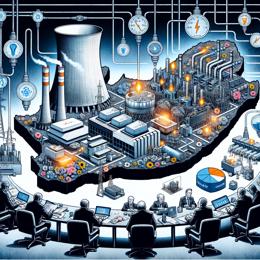
In a bold move that intertwines economic prudence with geopolitical finesse, South Africa's government has recently endorsed a strategic deal between PetroSA, the nation's state-owned oil company, and Gazprombank Africa, a subsidiary of Russia’s Gazprombank. This R3.7 billion collaboration comes as part of a broader initiative to revamp PetroSA's operations and was announced amidst concerns over possible international sanctions, a matter swiftly addressed by officials.
Minister in the Presidency Khumbudzo Ntshavheni addressed the media, affirming the Cabinet's decision and highlighting the significance of international partnerships. She elucidated that South Africa's comprehensive risk assessment guaranteed that the deal aligned with global trade regulations and the country's strategic interests within BRICS—a consortium of emerging economies comprising Brazil, Russia, India, China, and South Africa. The minister’s confidence signals the country's adept maneuvering of the complex geopolitical environment while striving for energy security and economic growth.
Under this agreement, Gazprombank is tasked with the refurbishment of PetroSA's gas-to-liquids (GTL) refinery in Mossel Bay, and in exchange, will receive a portion of the profits generated. The deal also includes the provision of gas condensate by the Russian bank until domestic natural gas supplies are adequate.
Despite the advent of load shedding—periodic interruptions in electric power supply that have plagued the nation—PetroSA has found a silver lining, leveraging these circumstances to furnish its operations and achieve an impressive turnover increase. This financial upliftment is seen as a promising sign for Gazprombank, suggesting a potentially lucrative future partnership.
Backing the Cabinet's perspective, independent political analyst Sandile Swana lauded PetroSA’s due diligence and emphasized the preexisting legal frameworks facilitating such a partnership. Swana reinforced the notion that South Africa's move to foster relations with Russia doesn't undermine its commitments to other international agreements, including its trade advantages under the African Growth and Opportunity Act (AGOA) with the United States.
South Africa's pursuit of enhanced fuel autonomy is evident in the government's prioritization of investments that promise tangible benefits and contribute to solving critical issues such as rising fuel prices. This partnership envisions a risk-and-reward sharing model, steering clear of any equity injection from Gazprombank Africa. The upcoming months are crucial, as parties undertake a comprehensive due diligence phase aimed at verifying the project’s bankability before committing to a final investment decision.
This collaboration is reflective of South Africa's determination to bolster its energy sector while also maintaining a delicate balance in its foreign relations, particularly against the backdrop of the U.S.'s hawkish stance on secondary sanctions. By solidifying alliances within the BRICS framework and asserting its global agency, South Africa underscores a diplomatic doctrine which ? not only seeks economic resilience but also fosters sovereignty in international decision-making.
Leave a Comment
Recent News