Content created by AI
South Africa’s Private Power Surge: Over 900MW Added But Battery Storage Challenges Loom
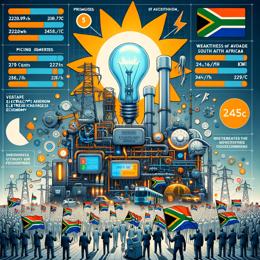
In an era bustling with green energy initiatives, South Africa has marked a significant milestone in private power generation. The National Energy Regulator of South Africa (Nersa) has registered 98 new generation facilities within the third quarter of 2023, cumulating an impressive combined capacity of 908MW. This figure verges closely on the 1,000MW typically withdrawn from the grid during each stage of Eskom’s load shedding, suggesting a potential tilt towards a more stabilized power supply in the country.
Despite these developments boding well for South Africa’s energy sector, a notable issue casts a shadow on the progress: the lack of battery storage capabilities. Nhlanhla Gumede, a Nersa member responsible for electricity generation, highlighted that most of the newly registered solar PV facilities are not equipped with battery storage systems. This detail holds significance since it positions the facilities' power generation strictly during daylight hours, sidestepping the critical need for energy storage to mitigate peak demand periods.
The concept of the “California Duck Curve” has surfaced to describe this predicament. The EIA's graph illustrates the divergence between peak solar power generation and peak electricity demand. The absence of battery storage exacerbates this phenomenon, where the majority – 92 out of the 98 facilities – without storage can output a maximum of 647MW, but cannot assist in alleviating evening peak power demands.
Geographically scattered across South Africa, with a concentration in Gauteng (19 projects) followed by the Western Cape and KwaZulu-Natal with 16 and 13 projects respectively, the spread indicates a nationwide drive towards renewable energy adoption. Yet, this expansive distribution also emphasizes the urgent need for energy storage solutions across the board.
The investment in these private power facilities is substantial, totaling R17.25 billion for the quarter. This financial input underscores the sector's vitality and the commitment to expanding South Africa's power generation capacity. The approved Nersa facilities since 2018 now boast a combined capacity of 5,785MW, at a cost of R111 billion, showcasing a cost-effective edge contrasting Eskom’s more colossal expenditures on its major power plants Medupi and Kusile.
The situation beckons for a broader strategy where future registration applications are encouraged, if not mandated, to include battery storage. This move would harmonize the private power sector with the pressing needs of the national grid, ensuring a more balanced and reliable energy ecosystem. It would involve a substantial additional investment, but one that would fortify the power grid's resilience against the backdrop of load shedding and unpredictable energy supplies.
Moreover, Nersa's latest registrations are not solely solar-centric. Two wind power projects in the Eastern Cape and Western Cape contribute 202MW to the green tapestry. And, representing diversity in renewable sources, Mpumalanga's co-generation projects (58MW) bring another dimension to the collective effort in transitioning away from fossil fuels.
In conclusion, while the addition of these facilities is a leap forward in South Africa's energy sector, the nation stands at a crossroads. Integrating battery storage into the burgeoning field of private power generation remains an imperative stride towards a fully sustainable and reliable energy future.
Leave a Comment
Recent News