Content created by AI
Electrifying Challenge: Minister Ramokgopa's Quest to Shield Essential Services from Load Shedding
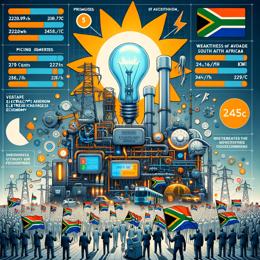
The Gauteng High Court's recent ruling brushed the South African government into a corned with a directive stark and unforgiving: implement mid-term measures to exempt essential services such as public health institutions, schools, and police stations from the agonizing grips of load shedding by the end of January—an exertion that may turn into a gargantuan task for Electricity Minister Kgosientsho Ramokgopa.
The decision emanated from discontent voiced by a conglomerate of political, labour, and community stakeholders who, in their dissatisfaction, beckoned high-profile government figures including President Cyril Ramaphosa and other ministers, as well as embattled national power utility Eskom, to the courts. The fundamental plea was to unveil a comprehensive strategy to halt the power outages disrupting daily lives—a strategy that seems scarcely visible on the horizon.
Judge Norman Davis's 66-page adjudication was unsparing in its critique of the government, denouncing its monumental failure to protect Eskom from the spiteful claws of criminal activity and state capture, phenomena that have deeply etched themselves into the energy crisis weaving through the nation.
But what does the court's ruling mean in practical terms? As energy experts weigh in, they expose the multitude of barriers that may impede the actualization of such a ruling. Energy specialist Lungile Mashele's insights reveal the complexity behind sparing specific facilities from outages—an act counterproductive to the very purpose of load shedding. Her counsel advocates instead for a proactive approach: fortifying such installations with solar photovoltaic (PV) systems and backup generators, a tactic partially mirrored in recent Chinese donations though these are constrained by a limited power capacity.
The challenges don't end there. Energy activist Peter Becker highlights the conundrum of municipal involvement, essential for a solution to take root, as Eskom’s tentacles do not extend to all areas uniformly. The conversation then drifts to the notion of redirecting load shedding away from these critical services, an idea that amasses scepticism about its feasibility and raises questions about the wider ramifications for the remaining population—who might, in turn, bear the brunt of intensified power cuts.
Peering deeper into the technical feasibility, nuclear civil engineer Hügo Krüger suggests that compromises will lead to a continually expanding list of "essential services," with a potentially unattainable logistical demand for tailored feed lines. Yet, Krüger also infuses a dose of optimism into the dialogue, estimating an end to load shedding within an achievable time frame, given visionary leadership and a robust policy framework.
Krüger's recipe for recovery includes repairing the ailing coal fleet, tapping into the domestic coal supply, and unleashing a vigorous renewable energy program bolstered by competitive private sector involvement—a departure from the monopolistic tendencies that have hobbled Eskom's efficiency.
On the international front, President Cyril Ramaphosa, speaking at COP28 in the United Arab Emirates, views the ruling in a more affirmative light. He perceives it as an endorsement of the government’s internal resolutions to safeguard essential services from the ravages of load shedding. The government's objectives, as he suggests, have already been in alignment with what the Gauteng High Court rigorously mandated.
The road ahead for Minister Ramokgopa is daunting yet inevitable. With the court's decree as a compass and the keen eyes of South Africans as witnesses, his ministry must navigate through an intricate labyrinth of infrastructural, policy, and societal expectations to bring stable power to those who serve the populace's most critical needs. Whether the proposed solutions will coalesce into a coherent, sustainable plan is the question that will keep South Africans plugged in for months to come.
#GOOGLE_AD
Leave a Comment
Recent News