Image: AI generated for illustration purposes
Unpacking South Africa's Green Growth Potential Amid Economic Challenges
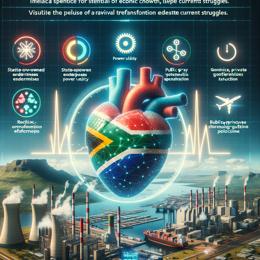
In a pivotal report from Harvard University's Growth Lab, the potential of 'green growth' is identified as a critical factor in remedying South Africa’s persistent economic downturn. Directed by esteemed Venezuelan economist Professor Ricardo Hausmann, the study provides a second insight, following involvement in South Africa's Accelerated & Shared Growth Initiative, aimed at evidence-based economic augmentation for the nation.
South Africa's challenges, as underscored in the report, primarily revolve around two facets: a deteriorating state capacity and continuing spatial exclusion. State capacity, as addressed, refers to a bureaucratic machinery struggling to implement developmental goals. Meanwhile, spatial exclusion – partly a hangover from apartheid-era policies – has stymied societal integration despite the government’s successful housing schemes.
The report makes a powerful assertion: demand-side maneuvers, reliant on fiscal stimulus, have faltered in spurring improvement. Instead, such tactics have worsened South Africa's credit profile, exacerbated capital costs, and limited social expenditure due to inflated debt serving commitments.
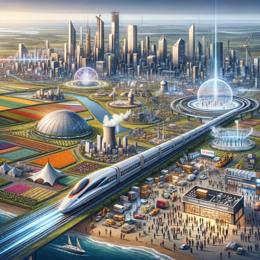
The insightful discourse by Hausmann extends beyond critical analysis and proposes a substantial and optimistic route forward based on the concept of 'green growth potential.' With the global move towards decarbonization, the dynamics of energy production and consumption are changing substantially. Renewable energy sources cannot traverse oceans as easily as coal or oil, leading to a paradigm shift towards localized 'green good' production.
This paradigm shift -- the pivot to local renewable energy utilization for manufacturing -- is central to Hausmann’s strategic vision for South Africa's renewal. South Africa’s renewable energy resources could indeed power the production of goods and services that a decarbonizing world demands. This foresight is augmented by existing economic structures, such as special economic zones, which could serve as foundational bases for export-oriented green manufacturing.
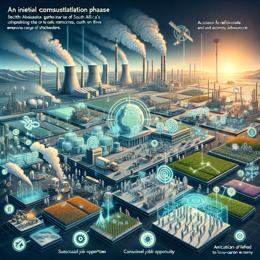
The drive towards a net-zero carbon economy is not merely an environmental imperative but represents a major economic and industrial opportunity – possibly one of the most significant capital reallocation events in history, as stated by a McKinsey study. South Africa is uniquely positioned to seize this transformative chance, provided the transition is well executed, taking into account the human element to avoid exacerbating inequality or societal tensions.
Capital and specialized support will, of course, be crucial in this transformative journey. South Africa has to leverage its position to combine these elements effectively and open the floodgates to green growth opportunities that could reverse the course of its economic distress.
As the head of ESG at Absa Corporate & Investment Banking, Msizi Khoza stands poised to meld capital, innovative ideas, and valuable insights to actualize South Africa's latent green growth potential, turning sweeping global changes into domestic economic triumphs.
Leave a Comment
Recent News